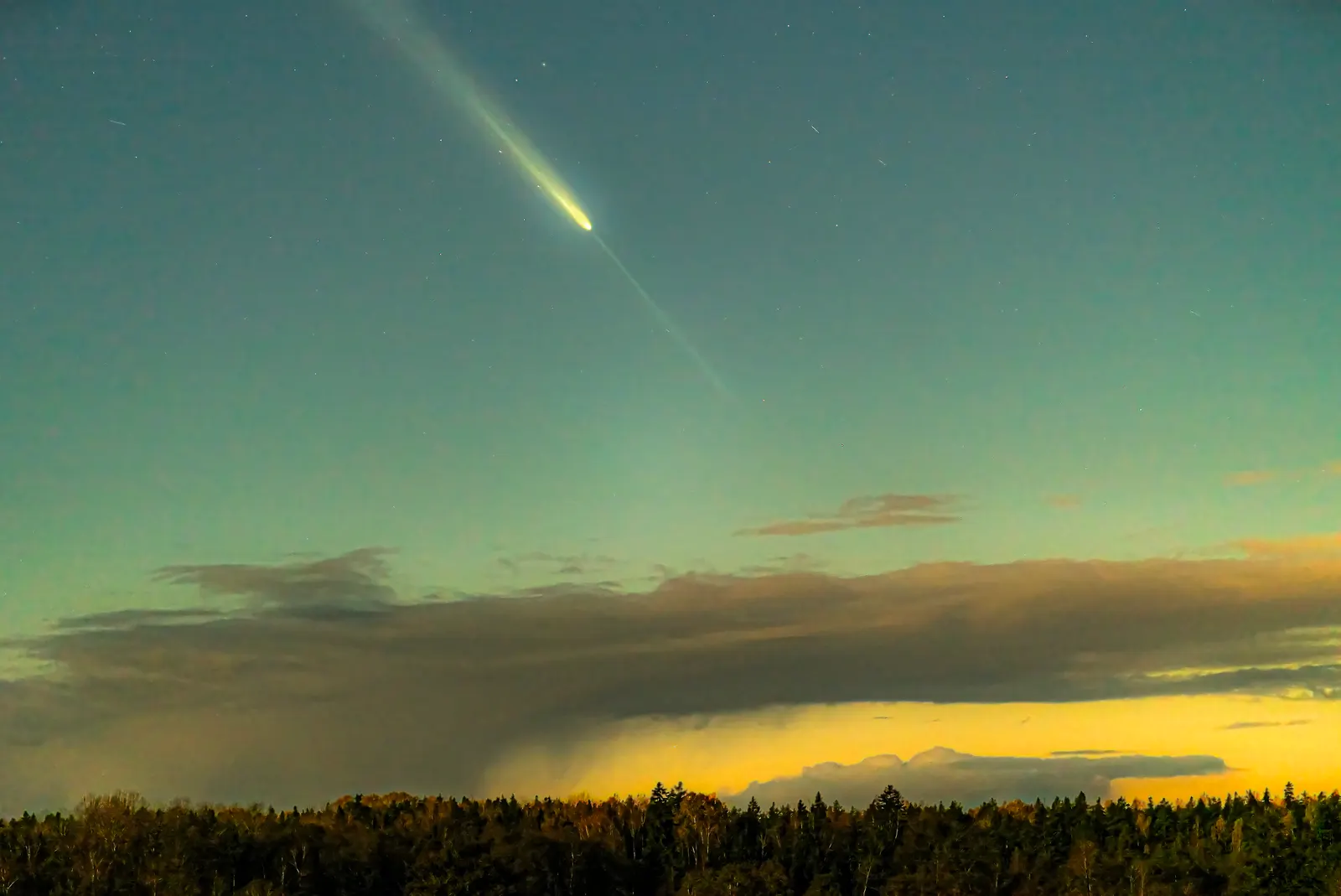
Comet Tsuchinshan-ATLAS, the bright naked-eye comet of October 2024, is leaving the inner solar system, possibly for good; its live distance is computed below.
This comet was first seen in January 2023 by the Purple Mountain Observatory in China, whose name in Chinese is Tsuchinshan, and found again a few weeks later by the ATLAS survey. It passed closest to the Sun on 27 September 2024, then 0.47 au from the Earth on 12 October, and became a fine naked-eye comet with a long tail in the evening sky. It came from the far reaches of the solar system, and its passage near the planets changed its orbit. A small push from a planet’s gravity can turn a closed orbit into an open one: if its speed is now above the escape speed, the comet will never come back and will drift away into interstellar space. That is why its departure may be for good.
First seen on 2023-01-09 by China’s Purple Mountain Observatory (Tsuchinshan) and found again on 2023-02-22 by the ATLAS survey in South Africa. It passed 0.39 au from the Sun on 2024-09-27 and 0.47 au from the Earth on 2024-10-12, a bright naked-eye comet with a long tail in the evening sky. It is now leaving the inner solar system, possibly for good, and can be followed only with telescopes.
Questions and answers
What is an au?
The astronomical unit, the average distance between the Earth and the Sun, about 150 million km.
Can I still see it?
Only with telescopes: it faded quickly as it moved away from the Sun and the Earth.
Where the numbers come from
Values refresh every second in your browser; the published data are checked every 10 minutes and updated several times a day.