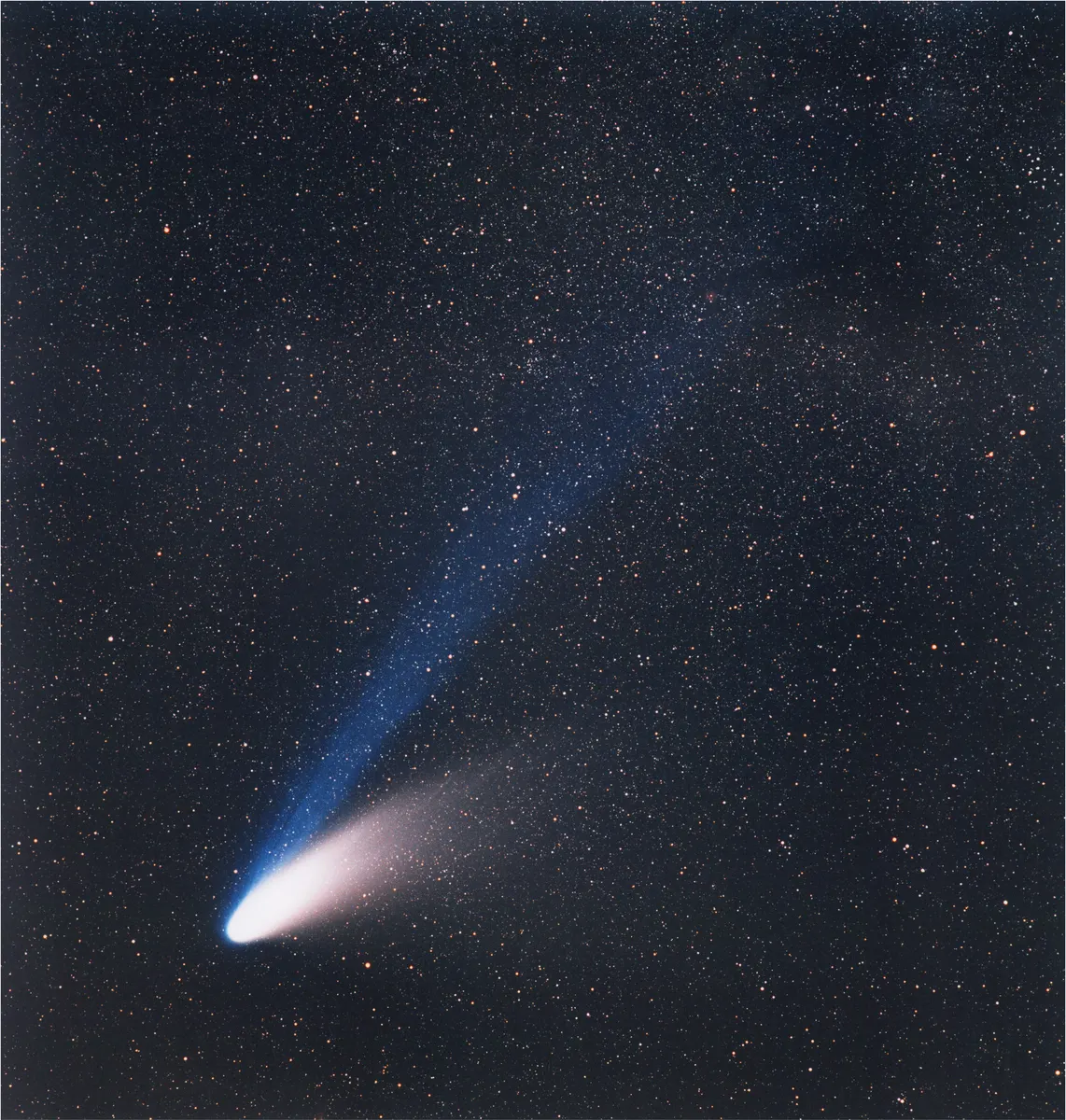
Comet Hale-Bopp, the great comet of 1997, stayed visible to the naked eye for about 18 months and is now far beyond the planets; its live distance is computed below.
Alan Hale in New Mexico and Thomas Bopp in Arizona found this comet on the same night, 23 July 1995, while it was still beyond Jupiter. To be visible so far from the Sun, it had to be big: its nucleus is about 60 km across, many times larger than a typical comet. Around its perihelion on 1 April 1997 millions of people saw it, with a bluish gas tail and a curved yellowish dust tail, and it stayed visible to the naked eye for about 18 months, a record. Hale-Bopp is a long-period comet: its orbit takes about 2,500 years and carries it far beyond Pluto, so no one alive today will see it again. The position shown follows it on that long journey outwards.
Discovered on 1995-07-23, independently, by Alan Hale in New Mexico and Thomas Bopp in Arizona, while it was still beyond Jupiter. Its nucleus, about 60 km across, is unusually large, and it stayed visible to the naked eye for about 18 months, a record, shining brightest around its perihelion on 1997-04-01. It goes around the Sun in about 2,500 years and is now far beyond the planets, within reach of large telescopes only.
Questions and answers
Can I still see Hale-Bopp?
Only with very large telescopes: it is now so far from the Sun that it has become a faint, frozen point.
What is a long-period comet?
A comet that takes more than 200 years to go around the Sun; most come from the Oort cloud, a vast, distant reservoir of icy bodies.
Where the numbers come from
Values refresh every second in your browser; the published data are checked every 10 minutes and updated several times a day.