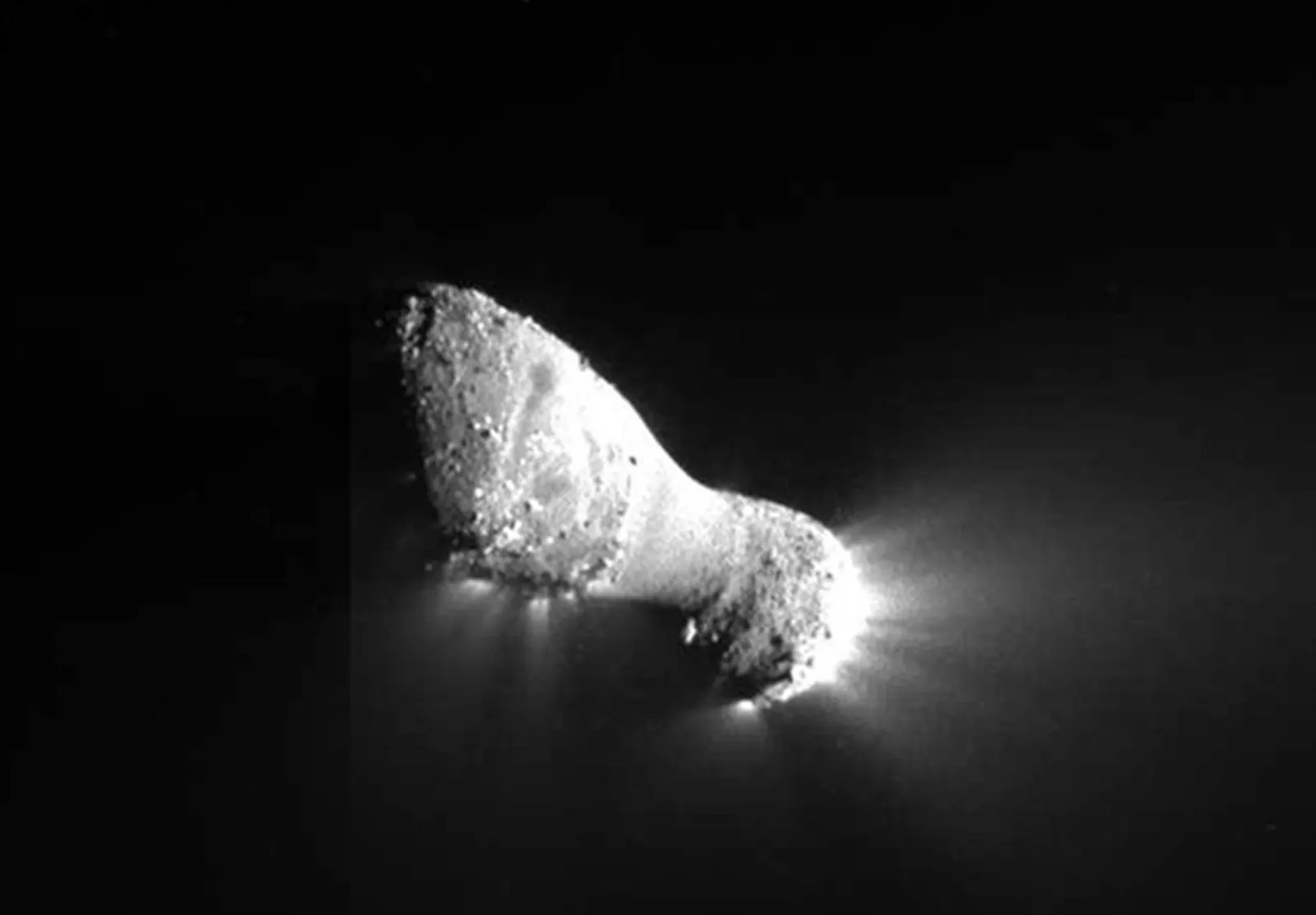
After striking Comet Tempel 1 in 2005, NASA’s Deep Impact spacecraft still had fuel, so it was sent on an extended mission, EPOXI, to a second comet. On 4 November 2010 it flew about 700 km from Hartley 2, discovered by Malcolm Hartley in Australia in 1986. The nucleus turned out to be tiny, a peanut 2.25 km long, yet it released far more water than its size suggested. The images explained why: jets of carbon dioxide gas burst from its rough ends, carrying chunks of ice into space, where they turned to vapour in sunlight. Such a small comet that is so active is called hyperactive. That year it reached about magnitude 5, faintly visible to the naked eye. It goes around the Sun every 6.5 years.