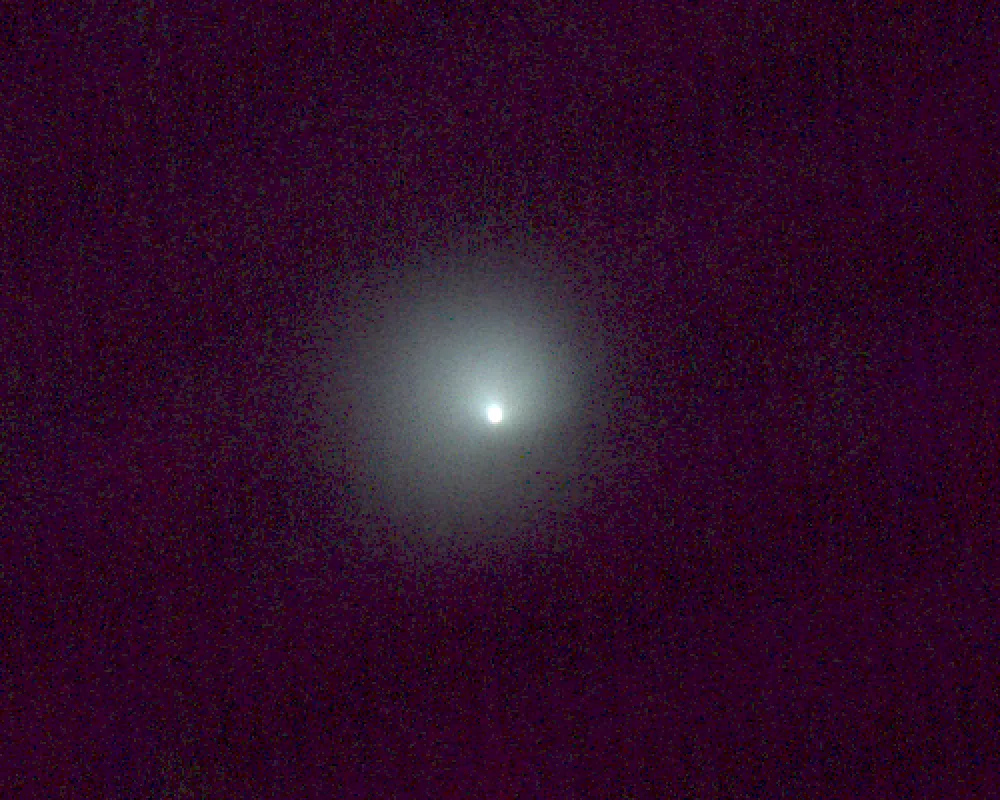
Comet Bernardinelli-Bernstein has the largest nucleus ever seen in a comet, about 130 km across, and is falling towards the Sun from the Oort cloud; its live distance is computed below.
Far beyond the planets, a vast cloud of icy bodies surrounds the solar system: the Oort cloud, too distant to be seen directly. Now and then, a passing star or the pull of our galaxy nudges one of these bodies onto a long fall towards the Sun, and it becomes a comet. Bernardinelli-Bernstein is one of them. Pedro Bernardinelli and Gary Bernstein found it in 2021 in archive images of the Dark Energy Survey, and in 2022 the Hubble Space Telescope showed that its nucleus is about 130 km across, some 50 times larger than most comets. It was spotted unusually early, while still very far away, so astronomers can watch an Oort cloud comet slowly warm up for years. It will pass closest to the Sun around January 2031, at about 10.9 au.
Telescope image · Nrco0e, from NASA/ESA Hubble Space Telescope data, CC BY-SA 4.0 · source
About Comet Bernardinelli-Bernstein
Designation
C/2014 UN271 (Bernardinelli-Bernstein)
Type
Long-period comet
Discovered
2021-06
Nucleus diameter
130 km
Today
Found in 2021 by Pedro Bernardinelli and Gary Bernstein in archive images of the Dark Energy Survey, taken from Chile. In 2022 the Hubble Space Telescope showed that its nucleus is about 130 km across, the largest ever seen in a comet, some 50 times larger than most. It comes from the Oort cloud and will pass closest to the Sun around January 2031, at about 10.9 au, just beyond Saturn’s orbit. It will remain a telescope target.
Questions and answers
Will it become a bright comet?
No: even at its closest it stays just beyond Saturn’s orbit, too far from the Sun and the Earth, so it will remain a telescope target.
How can Hubble measure a hidden nucleus?
Astronomers subtracted the glow of the surrounding coma from Hubble’s images, leaving the light of the nucleus, then worked out its size from how much light it reflects.
Where the numbers come from
Values refresh every second in your browser; the published data are checked every 10 minutes and updated several times a day.