Perigee FR

Where is the asteroid Annefrank now?

Annefrank, a small stony main-belt asteroid about 6.6 km long, was photographed by NASA’s Stardust in 2002; its live distance is computed below.

Live 3D view: Annefrank

On 2 November 2002, NASA’s Stardust passed about 3,080 km from Annefrank and showed an irregular stony asteroid about 6.6 km long. The flyby was a rehearsal: the team practised following a small object at high speed before the real target, comet Wild 2, whose dust Stardust collected in 2004 and brought back to the Earth. Annefrank also shows how asteroids get their names. Once a new asteroid’s orbit is known well enough, it receives a number, and its discoverer may propose a name, which a committee of the International Astronomical Union approves. Karl Reinmuth found this one from Heidelberg in 1942; it was named after Anne Frank, the young diarist who died in a Nazi camp.
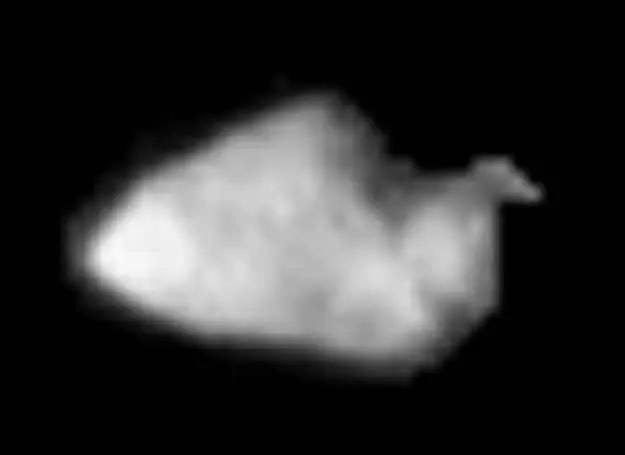
Annefrank
Image taken by the spacecraft · NASA/JPL-Caltech, public domain · source

About Annefrank

Designation
5535 Annefrank
Group
Main asteroid belt
Mean diameter
5 km
Rotation period
15 h
Discovered
1942-03-23 (Karl Reinmuth)

Today

NASA’s Stardust flew past it on 2002-11-02 at about 3,080 km, a rehearsal for its encounter with comet Wild 2. Its images showed an irregular stony asteroid about 6.6 km long. Karl Reinmuth discovered it at Heidelberg on 1942-03-23; it is named after Anne Frank, the young diarist who died in a Nazi camp.

Questions and answers

What did Stardust bring back?

Dust from comet Wild 2, caught in aerogel, an extremely light foam, and returned in a capsule that landed in Utah in January 2006.

Why is the name written in one word?

Asteroid names are usually a single word, so the first name and surname are joined: Annefrank, like Donaldjohanson.

Where the numbers come from

Values refresh every second in your browser; the published data are checked every 10 minutes and updated several times a day.