Perigee FR

Where is the asteroid Braille now?

Braille, an asteroid about 2 km long whose orbit crosses that of Mars, was flown past by NASA’s Deep Space 1 in 1999; its live distance is computed below.

Live 3D view: Braille

NASA’s Deep Space 1 was a test mission for new technology, above all an ion engine. Instead of burning fuel, such an engine uses electricity from solar panels to shoot out charged atoms very fast. Its push is tiny, about the weight of a sheet of paper, but it can last for months and, in the end, gives much more speed for the same fuel than a chemical rocket. On 29 July 1999 the probe passed only 26 km from Braille, but its camera lost track of the asteroid during the approach and the close-up images were missed; only more distant views came back. Braille was discovered at Palomar by Eleanor Helin and Kenneth Lawrence in 1992.
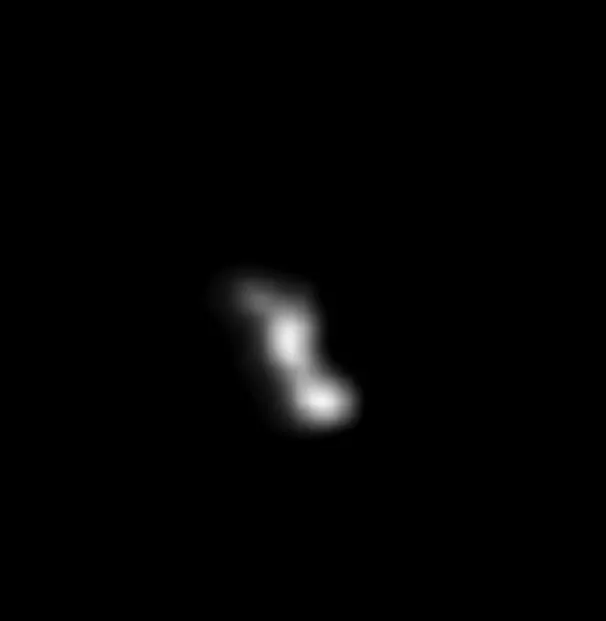
Braille
Image taken by the spacecraft · NASA/JPL-Caltech/UMD, public domain · source

About Braille

Designation
9969 Braille
Group
Mars-crosser
Mean diameter
2 km
Rotation period
226 h
Discovered
1992-05-27 (Eleanor Helin, Kenneth Lawrence)

Today

NASA’s Deep Space 1 flew past it on 1999-07-29 at only 26 km, but its camera lost track of it during the approach and the close-up images were missed. Braille is about 2 km long and its orbit crosses that of Mars. Discovered at Palomar by Eleanor Helin and Kenneth Lawrence on 1992-05-27, it is named after Louis Braille, who invented the writing system used by blind people.

Questions and answers

What is a Mars-crosser?

An asteroid whose orbit crosses the orbit of Mars without coming as close to the Sun as the near-Earth asteroids do.

Why is it named after Louis Braille?

To honour the Frenchman who, blind from childhood, invented the raised-dot writing that blind people read with their fingers.

Where the numbers come from

Values refresh every second in your browser; the published data are checked every 10 minutes and updated several times a day.