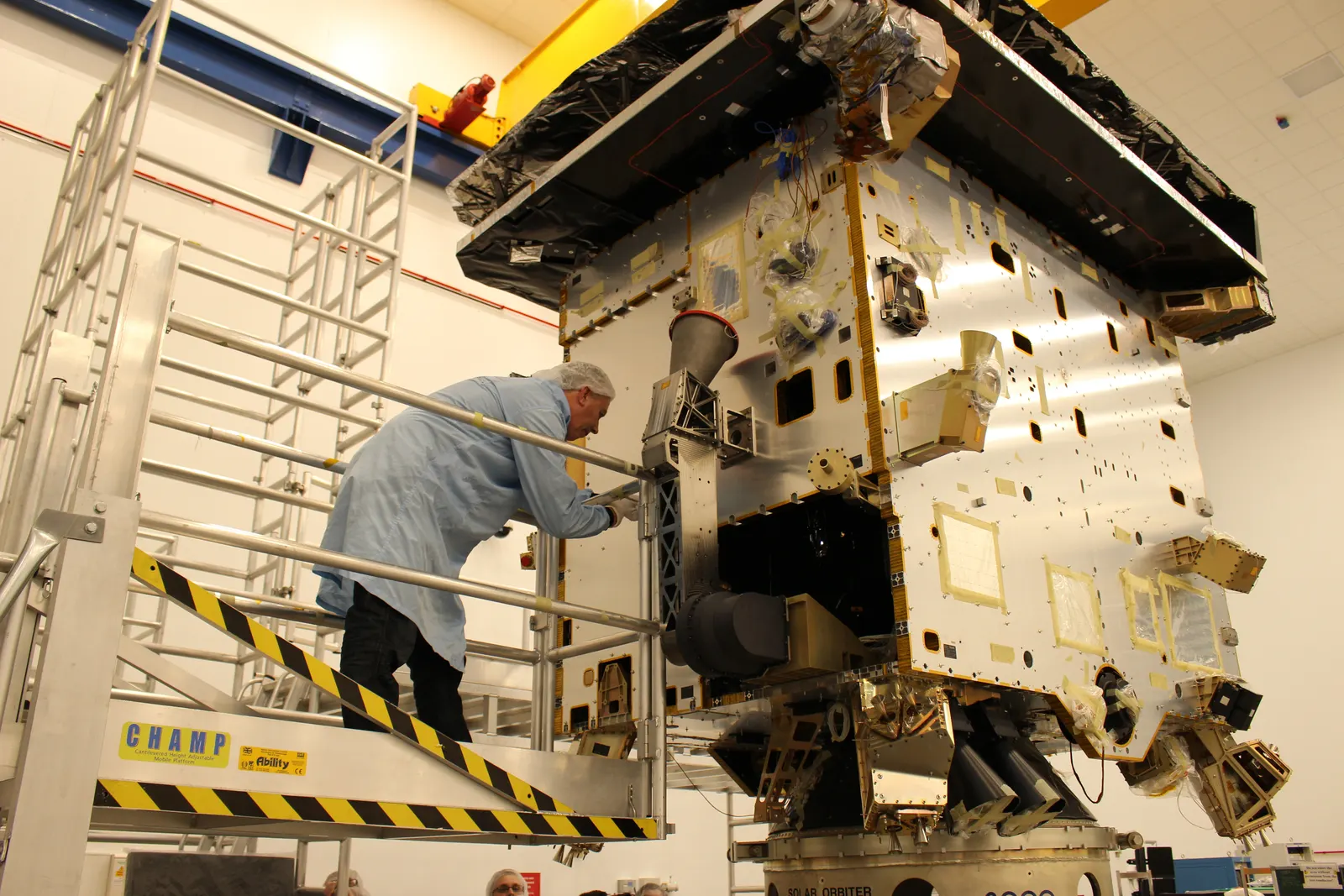
Solar Orbiter, a European Space Agency mission with NASA, was launched on 10 February 2020. Its orbit brings it inside the orbit of Mercury, about 42 million km from the Sun, where its cameras take close-up pictures while other instruments sample the solar wind that flows past. Flybys of Venus are slowly tilting its orbit out of the plane of the planets, and in 2025 it sent the first-ever pictures of the Sun’s south pole. The poles hold clues to the magnetic cycle that, every eleven years or so, makes sunspots come and go.
Replica or test model · UCL Mathematical and Physical Sciences, CC BY 2.0 · source
About Solar Orbiter
Agency
ESA / NASA
Launched
2020-02-10
Status
Active
Goals
Solar Orbiter combines close-up images of the Sun with measurements of the solar wind around the spacecraft, linking the particles to the regions of the Sun they came from. It seeks to explain the 11-year cycle of solar activity, the heating of the corona to millions of degrees and the origin of the solar wind. Its tilted orbit gives the first views of the Sun's poles, key to understanding its magnetic field.
Today
Mission extension approved by ESA's Science Programme Committee (June 2026). Further Venus flybys 2028-03-18, 2029-06-10, 2030-09-02 raise inclination to 33°. Next perihelion 2027-02-06 (0.28 AU).
Parker flies much closer but carries no camera looking straight at the Sun; Solar Orbiter stays farther away and takes pictures, and it looks at the poles.
Why look at the Sun’s poles?
The Sun’s magnetic field flips every eleven years or so, and the poles show how that cycle works; from the Earth we only see them at a grazing angle.
Where the numbers come from
Values refresh every second in your browser; the published data are checked every 10 minutes and updated several times a day.