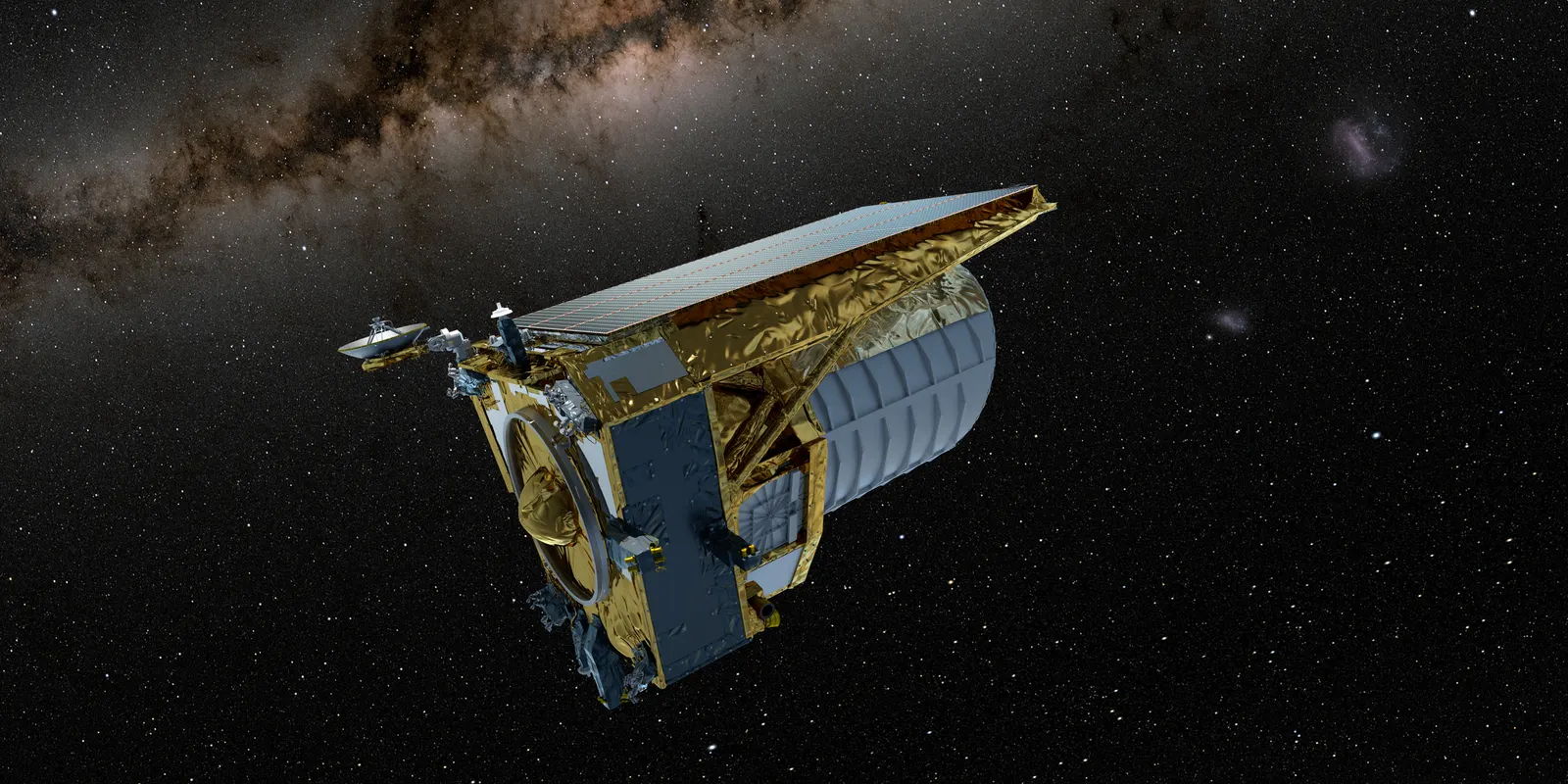
Euclid, a European Space Agency telescope launched on 1 July 2023, shares the neighbourhood of the James Webb telescope: it orbits the Sun–Earth L2 point, about 1.5 million km from the Earth. Its job is to map billions of galaxies over a third of the sky and measure how their shapes are slightly bent by unseen matter, and how the expansion of the universe has changed over ten billion years. Those measurements test our ideas about dark matter and dark energy, which together make up about 95 % of the universe but have never been seen directly. Euclid publishes its survey in instalments.
Euclid is investigating dark energy and dark matter, the mysterious components that make up most of the Universe. It is mapping billions of galaxies over more than a third of the sky, looking back about 10 billion years, to see how cosmic structures grew and how the expansion of the Universe has changed over time. This tests how gravity behaves on the largest scales.
Today
Quick release Q2 (Galactic Bulge) on 2026-06-24; complete DR1 mid-2027. Still in its prime science phase (not part of the June 2026 extension round).
A place about 1.5 million km beyond the Earth, on the side away from the Sun, where a spacecraft can keep pace with the Earth around the Sun with little fuel.
What is dark matter?
Matter that we detect only through its gravity: it bends light and holds galaxies together, but emits no light of its own.
Where the numbers come from
Values refresh every second in your browser; the published data are checked every 10 minutes and updated several times a day.