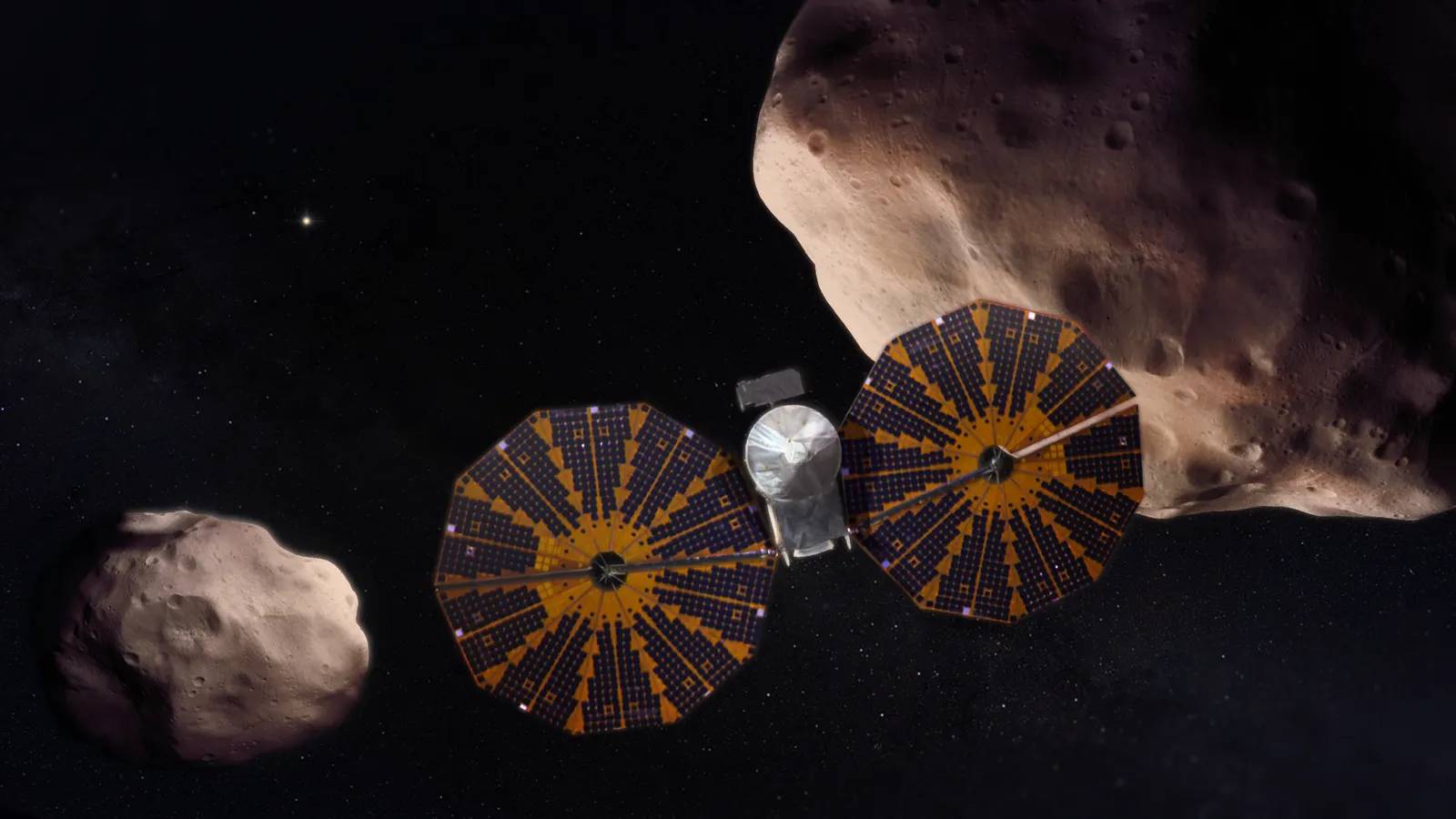
Lucy, launched on 16 October 2021, is the first mission to the Trojan asteroids: two swarms of small bodies that share Jupiter’s orbit, one ahead of the planet and one behind. They are leftovers from the birth of the planets, like fossils of the early solar system, which is why the mission is named after the famous fossil of a human ancestor. On the way, Lucy flew past the small asteroid Dinkinesh in 2023, discovering it has a moon, and past Donaldjohanson in 2025. It reaches the Trojans in 2027 and should visit several of them until 2033, returning to the Earth between swarms.
Illustration (artist’s impression) · NASA’s Goddard Space Flight Center/Conceptual Image Lab/Adriana Gutierrez, public domain · source
About Lucy
Agency
NASA
Launched
2021-10-16
Status
Cruise
Goals
Lucy is the first mission to the Trojan asteroids, two swarms that share Jupiter's orbit around the Sun, one ahead of the planet and one behind it. These bodies are thought to be leftovers of the material that built the outer planets, time capsules from the birth of the Solar System over four billion years ago. By flying past eleven asteroids of different types, Lucy tests models of how the planets formed.
Today
Camera tests on future targets in spring 2026. Then Polymele 2027-09-15, Leucus 2028-04-18, Orus 2028-11-11, Patroclus-Menoetius 2033-03-03. Past: Dinkinesh 2023-11-01, Donaldjohanson 2025-04-20.
Asteroids gathered at two balance points of Jupiter’s orbit, 60° ahead of and behind the planet, where the gravity of the Sun and Jupiter keeps them in place.
Why is the mission called Lucy?
After the fossil skeleton of an early human ancestor found in Ethiopia in 1974, which taught us about our origins, as the Trojans may about the planets’.
Where the numbers come from
Values refresh every second in your browser; the published data are checked every 10 minutes and updated several times a day.