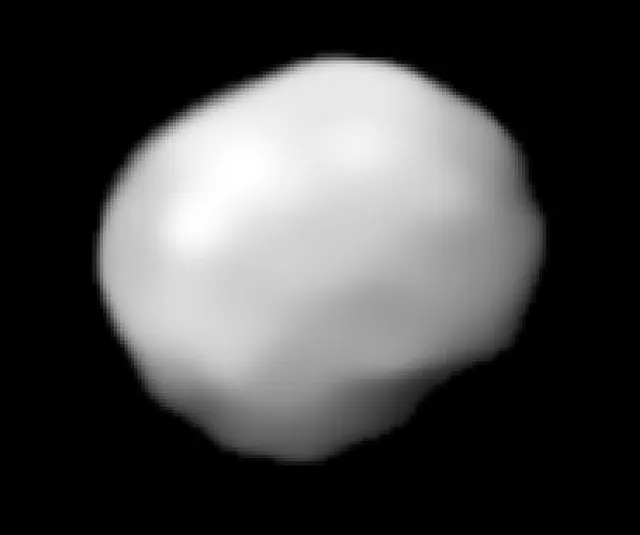
Interamnia, about 332 km across, is the largest asteroid after Ceres, Vesta, Pallas and Hygiea, yet one of the least studied. Vincenzo Cerulli discovered it on 2 October 1910. How can we guess what it is made of without visiting it? One clue is its density: its mass divided by its volume. Telescopes give its size, hence its volume; its mass comes from the tiny tugs its gravity gives other asteroids passing nearby. Rock is denser than ice, so a low density means a mix of rock with something lighter, or empty spaces inside. Interamnia’s density is low, and its surface shows minerals that formed in contact with water, which suggests that it may still hold ice.