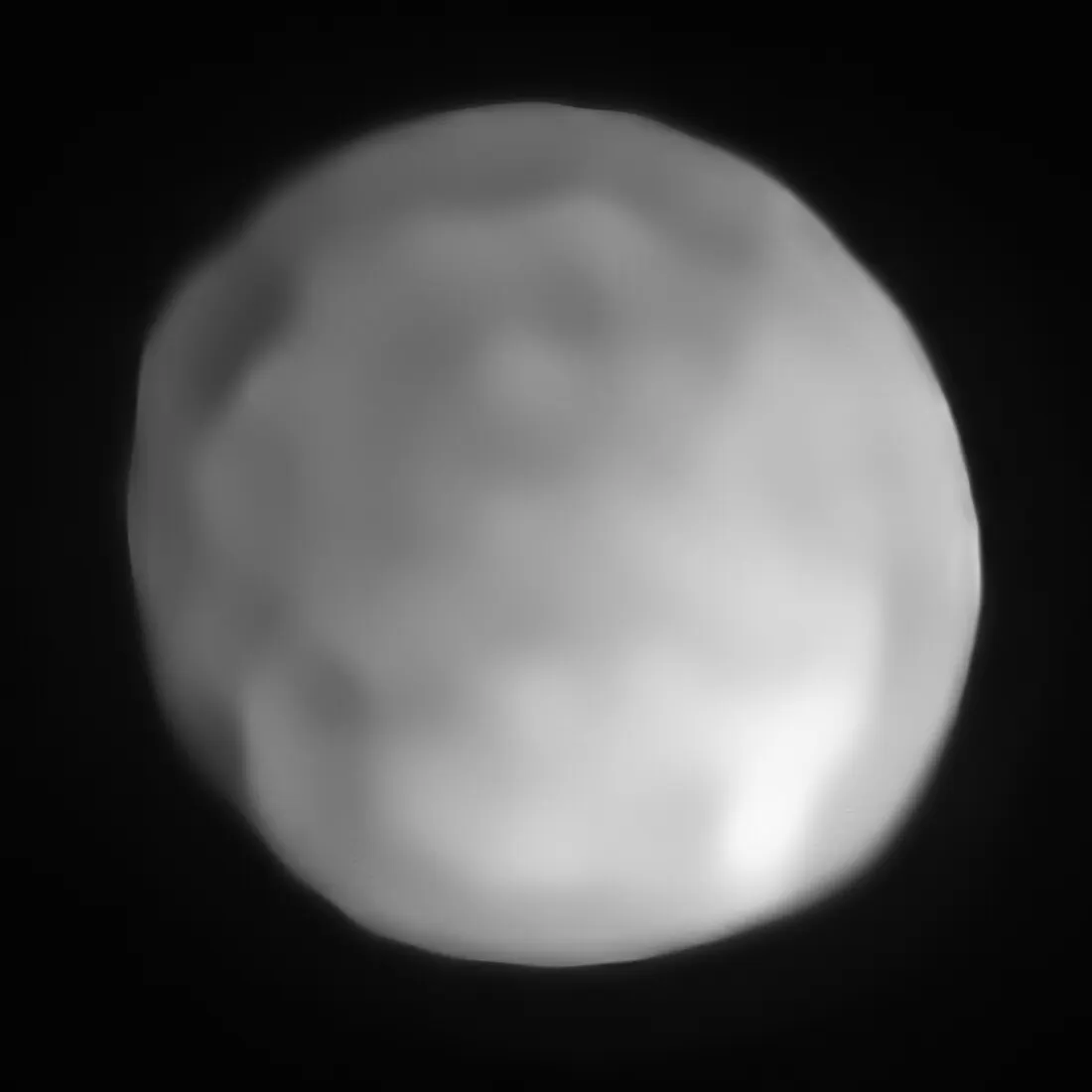
Hygiea, the fourth-largest body of the asteroid belt, is so nearly round that it might count as a dwarf planet; its live distance is computed below.
Hygiea was discovered by Annibale de Gasparis in Naples on 12 April 1849. Dark and rich in carbon, it is about 433 km across. Why does its shape matter? Every body pulls on itself with its own gravity. A small asteroid is too weak to change its shape, so it stays a lumpy rock; a large enough body squeezes itself into a ball. Being round is one of the conditions for a dwarf planet, together with orbiting the Sun and not being a moon. Images from ESO’s Very Large Telescope in 2017–2018 showed that Hygiea is nearly round, so it might qualify, but the International Astronomical Union has not reclassified it. Astronomers think a giant impact once shattered it and its pieces gathered again into a sphere.
Telescope image · ESO/P. Vernazza et al./MISTRAL algorithm (ONERA/CNRS), CC BY 4.0 · source
About Hygiea
Designation
10 Hygiea
Group
Main asteroid belt
Mean diameter
433 km
Rotation period
14 h
Discovered
1849-04-12 (Annibale de Gasparis)
Today
The fourth-largest body of the asteroid belt, dark and rich in carbon, discovered by Annibale de Gasparis in Naples on 1849-04-12. Images from ESO’s Very Large Telescope in 2017–2018 showed that it is nearly round, so it might qualify as the smallest dwarf planet of the Solar System; the International Astronomical Union has not reclassified it. It is the largest member of the Hygiea family, asteroids born from a giant impact on it.
Questions and answers
Is Hygiea a dwarf planet?
Not officially: the International Astronomical Union decides, and it has not reclassified Hygiea. Ceres remains the only recognised dwarf planet of the asteroid belt.
What is the Hygiea family?
A group of smaller asteroids on orbits like Hygiea’s: fragments thrown out by a giant impact on it long ago.
Where the numbers come from
Values refresh every second in your browser; the published data are checked every 10 minutes and updated several times a day.