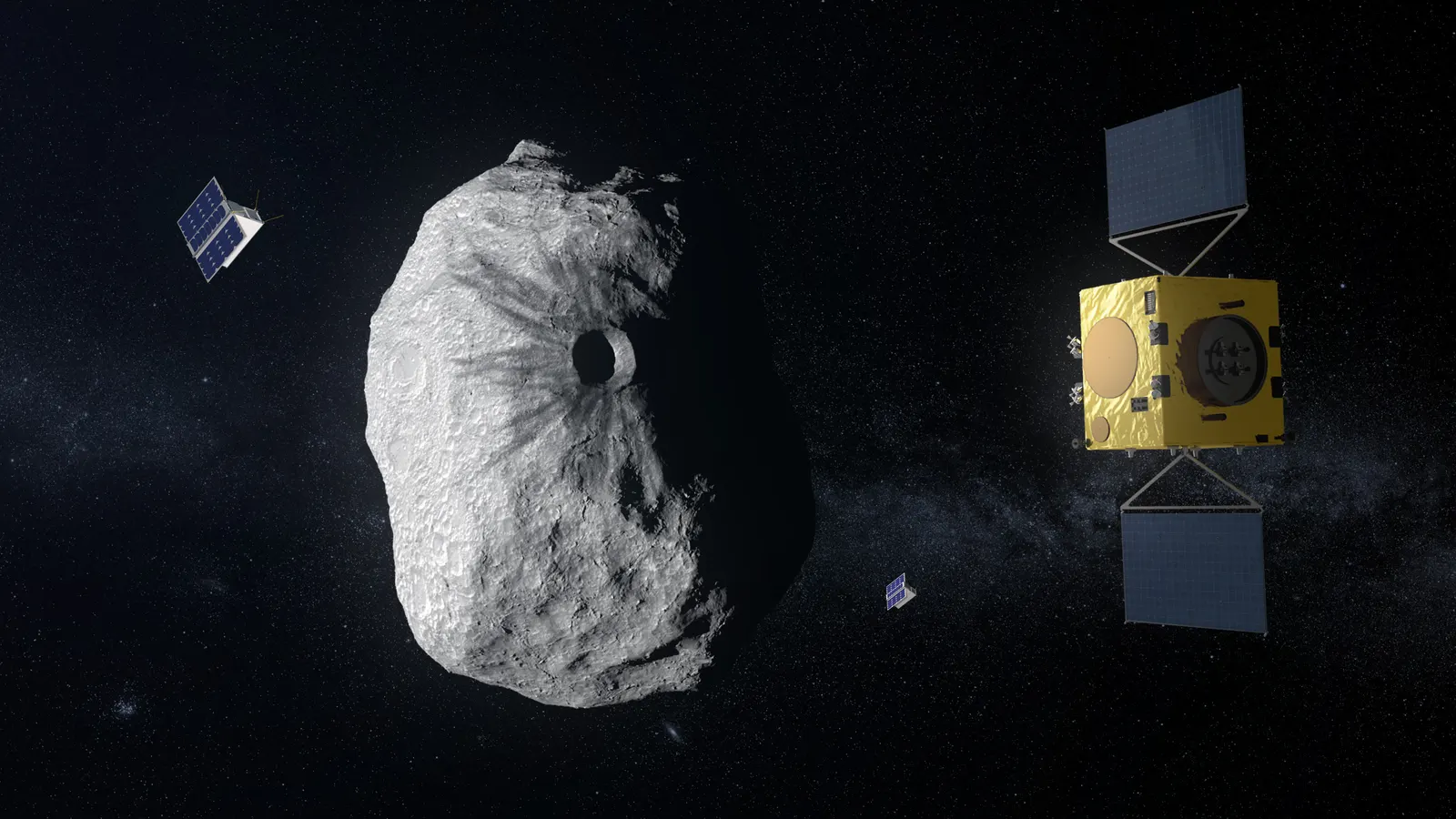
ESA’s Hera is the mission to the double asteroid Didymos, whose small moon was struck by NASA’s DART probe; its live distance is computed below.
Hera, launched on 7 October 2024, is Europe’s planetary defence mission. In September 2022, NASA’s DART spacecraft deliberately crashed into Dimorphos, the small moon of the asteroid Didymos, and shortened its orbit: the first time humans moved a natural body in space. Hera’s job is to measure the result in detail, including the crater, the mass of Dimorphos and how its shape changed, so that the experiment becomes a technique we understand well enough to repeat if a dangerous asteroid ever threatens the Earth. ESA planned its arrival for November 2026, followed by a six-month survey with two small CubeSats, Milani and Juventas. Hera is the first probe to visit a binary asteroid, two bodies orbiting each other.
Hera is Europe's planetary defence mission. It surveys the binary asteroid Didymos and its small moon Dimorphos, which NASA's DART spacecraft deliberately struck to change its orbit, measuring the result of the impact in detail. This turns the DART experiment into a well-understood, repeatable technique for deflecting a dangerous asteroid. Hera is also the first probe to visit a binary asteroid and tests autonomous navigation close to asteroids.
Today
ESA targets arrival in November 2026, a month earlier than planned (an older ESA ops page mentions an 'impulsive rendezvous' in October 2026). Second deep-space manoeuvre March 2026 (367 m/s). Six-month survey of DART's impact aftermath; releases CubeSats Milani and Juventas.