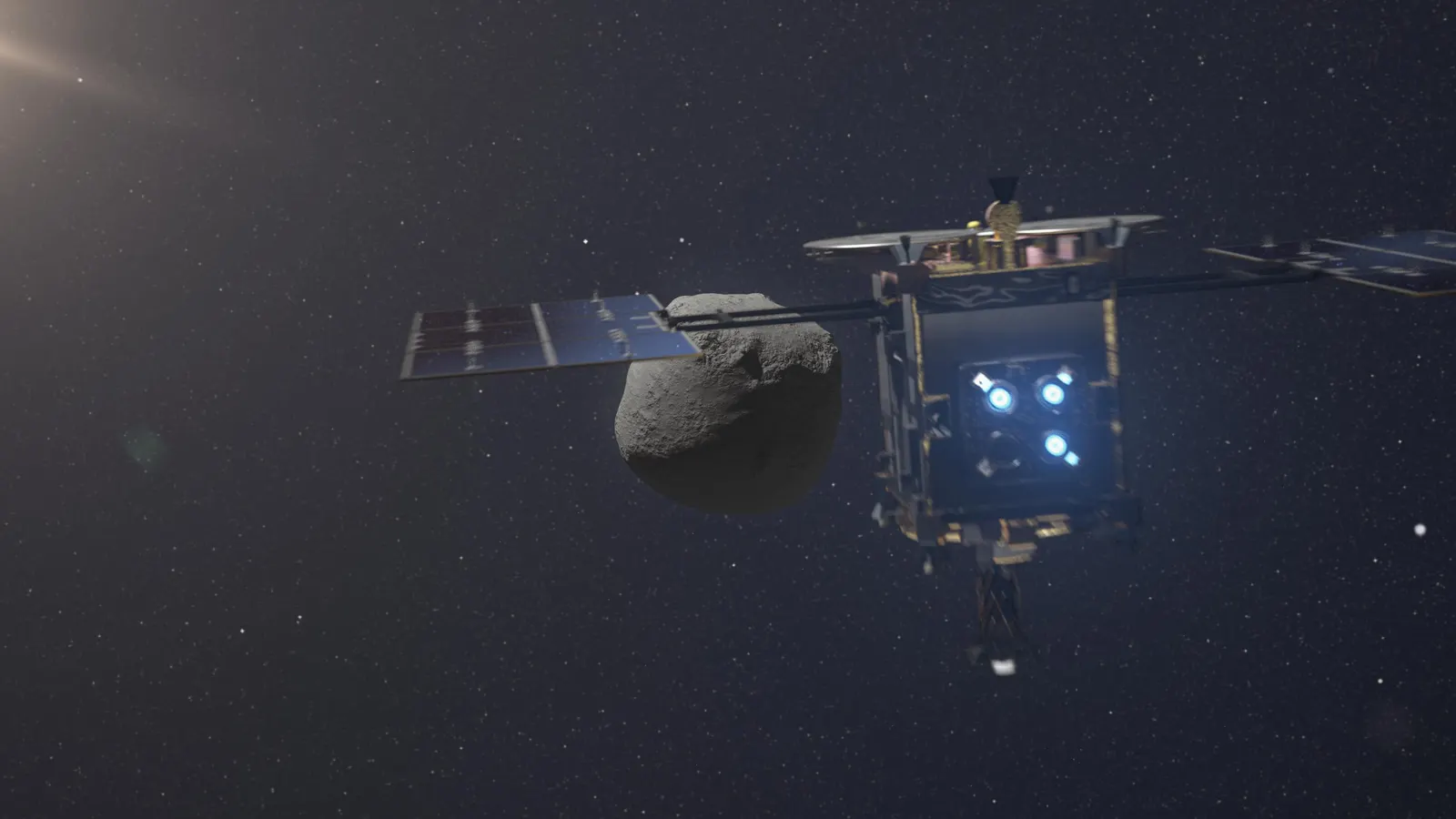
JAXA’s Hayabusa2, which brought back samples of asteroid Ryugu, is on an extended voyage around the Sun towards the tiny asteroid 1998 KY26; its live distance is computed below.
Hayabusa2, a Japanese probe launched on 3 December 2014, explored the carbon-rich asteroid Ryugu and collected material from its surface. In December 2020 it flew past the Earth and released a small capsule that landed in Australia with the samples: grains that hold clues about how the solar system formed and where the Earth’s water and the ingredients of life came from. The mother probe did not come home; it still had fuel, so JAXA sent it on an extended mission called Hayabusa2#. On 5 July 2026 it flew about 400 m from asteroid Torifune, a rehearsal for planetary defence. After passing the Earth in 2027 and 2028, it should reach 1998 KY26, an asteroid only about 11 m wide that spins in about five minutes, in 2031.
Illustration (artist’s impression) · DLR, CC BY 2.0 · source
About Hayabusa2 (Hayabusa2#)
Agency
JAXA
Launched
2014-12-03
Status
Cruise
Goals
Hayabusa2 explored the carbon-rich asteroid Ryugu and brought samples back to Earth, to learn how the Solar System formed and where Earth's water and the organic matter linked to life came from. Its extended mission, Hayabusa2#, uses its remaining fuel to fly past asteroid Torifune, a planetary defence rehearsal, and then reach 1998 KY26, a tiny asteroid about 11 m wide that spins in about 5 minutes.
Today
Flew past asteroid Torifune (2001 CC21) on 2026-07-05 at ~400 m, the closest flyby of any Solar System body; first laser ranging during an asteroid flyby. Earth swing-bys 2027 and 2028.
Laboratories on the Earth have instruments far more powerful than any probe can carry, and samples can be studied again for decades with new techniques.
Why go to such a tiny asteroid?
Small, fast-spinning asteroids are the most common kind to come near the Earth, yet none has been visited; knowing them helps to plan how to deflect one.
Where the numbers come from
Values refresh every second in your browser; the published data are checked every 10 minutes and updated several times a day.