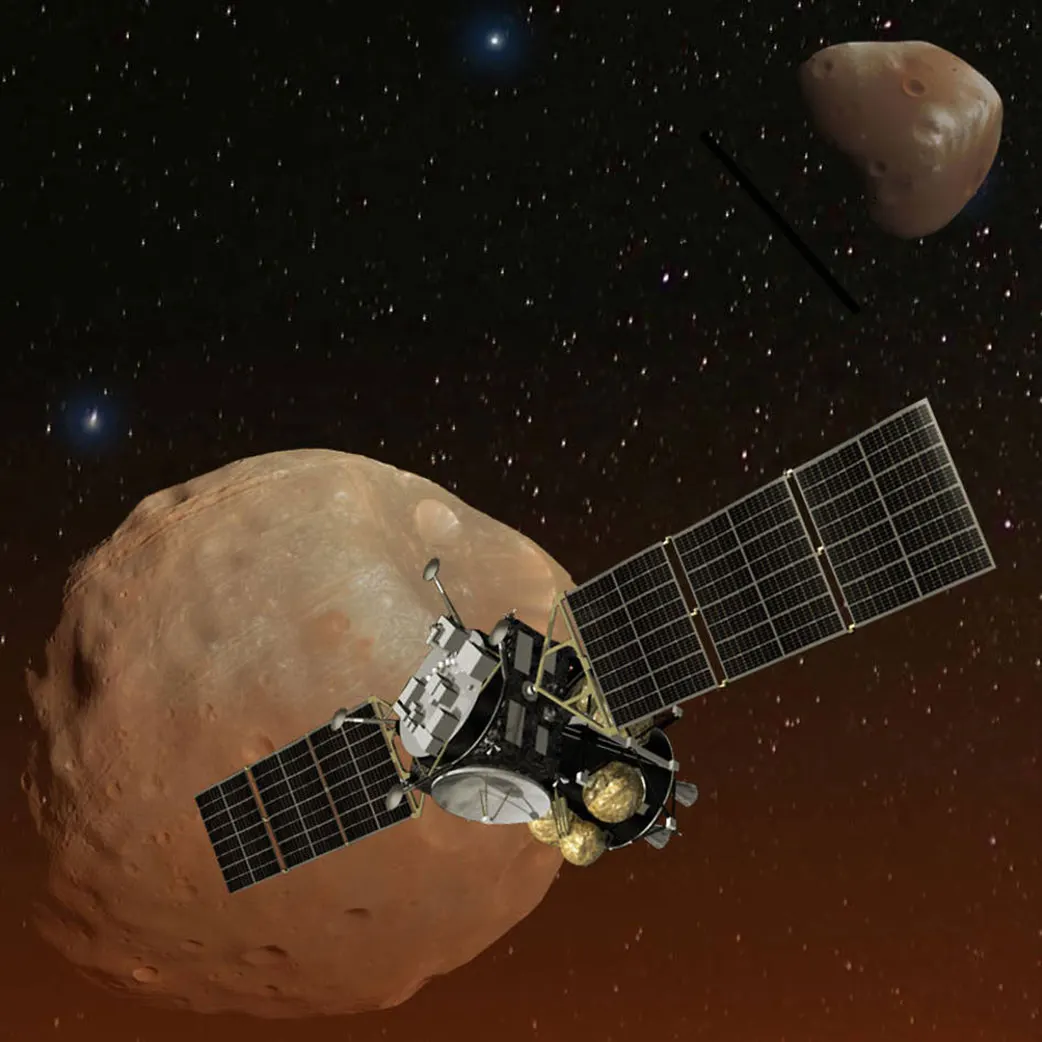
JAXA’s MMX is cruising around the Sun towards Mars, to bring back a sample of its moon Phobos; its live distance is computed below.
MMX, for Martian Moons eXploration, is a Japanese mission launched on 19 October 2026 by an H3 rocket from Tanegashima; two days later it had unfolded its solar panels and was in good health. It is heading for Phobos and Deimos, the two small moons of Mars, which it should reach in 2027 after about a year of cruise around the Sun. It will study both moons up close, then land on Phobos to collect at least 10 grams of its soil and bring them back to the Earth around 2031. This is a sample return: material studied in laboratories on the Earth reveals far more than any instrument a probe can carry. The samples should tell whether these moons are captured asteroids or debris thrown out by a giant impact on Mars.
Illustration (artist’s impression) · NASA, public domain · source
About Martian Moons eXploration (MMX)
Agency
JAXA
Launched
2026-10-19
Status
Cruise
Goals
MMX (Martian Moons eXploration) is a Japanese mission to Phobos and Deimos, the two moons of Mars. It will study both moons from close up, land on Phobos to collect at least 10 grams of its surface and bring them back to Earth, to find out whether these moons are captured asteroids or debris from a giant impact on Mars. It carries IDEFIX, a small French–German rover.
Today
Launched 2026-10-20 04:41:03 JST (= 2026-10-19 19:41:03 UTC) on H3 F10 from Tanegashima; the rocket placed MMX into its planned orbit about 71 minutes after liftoff. Carries the CNES/DLR IDEFIX rover and NASA MEGANE. NORAD 101109 / COSPAR 2026-236A; centred on the Sun during the heliocentric cruise (switches to Mars once in the Martian system). JAXA declared the initial critical operations phase complete on 2026-10-21, with the spacecraft in good health after deploying its solar array paddles, achieving three-axis attitude control and releasing the medium-gain antenna hold-down mechanism; it now runs initial functional checks before outbound cruise operations.
Phobos’s gravity is so weak that taking off again needs very little fuel, while leaving the surface of Mars would need a rocket; and the origin of the moons tells us about the early history of Mars.
Does MMX carry a rover?
Yes: IDEFIX, a small rover built by the French and German space agencies, which should roll on Phobos.
Where the numbers come from
Values refresh every second in your browser; the published data are checked every 10 minutes and updated several times a day.