Perigee FR

Where is Halley’s Comet now?

Halley’s Comet comes back near the Sun about every 76 years and was last seen in 1986; its live distance is computed below.

Live 3D view: Halley’s Comet

For centuries comets were seen as surprises in the sky. Edmond Halley, using Isaac Newton’s new law of gravity, noticed that the comets of 1531, 1607 and 1682 followed almost the same path, and concluded that they were one comet on a stretched orbit around the Sun. He predicted its return for 1758; it was found again on 25 December of that year, years after his death, a triumph for Newton’s physics. Halley’s Comet spends most of its 76-year orbit far beyond the planets, where it is a dark lump of ice too faint to see, and becomes bright only during the few months it spends near the Sun. Its orbit is retrograde: it travels around the Sun in the opposite direction to the planets.
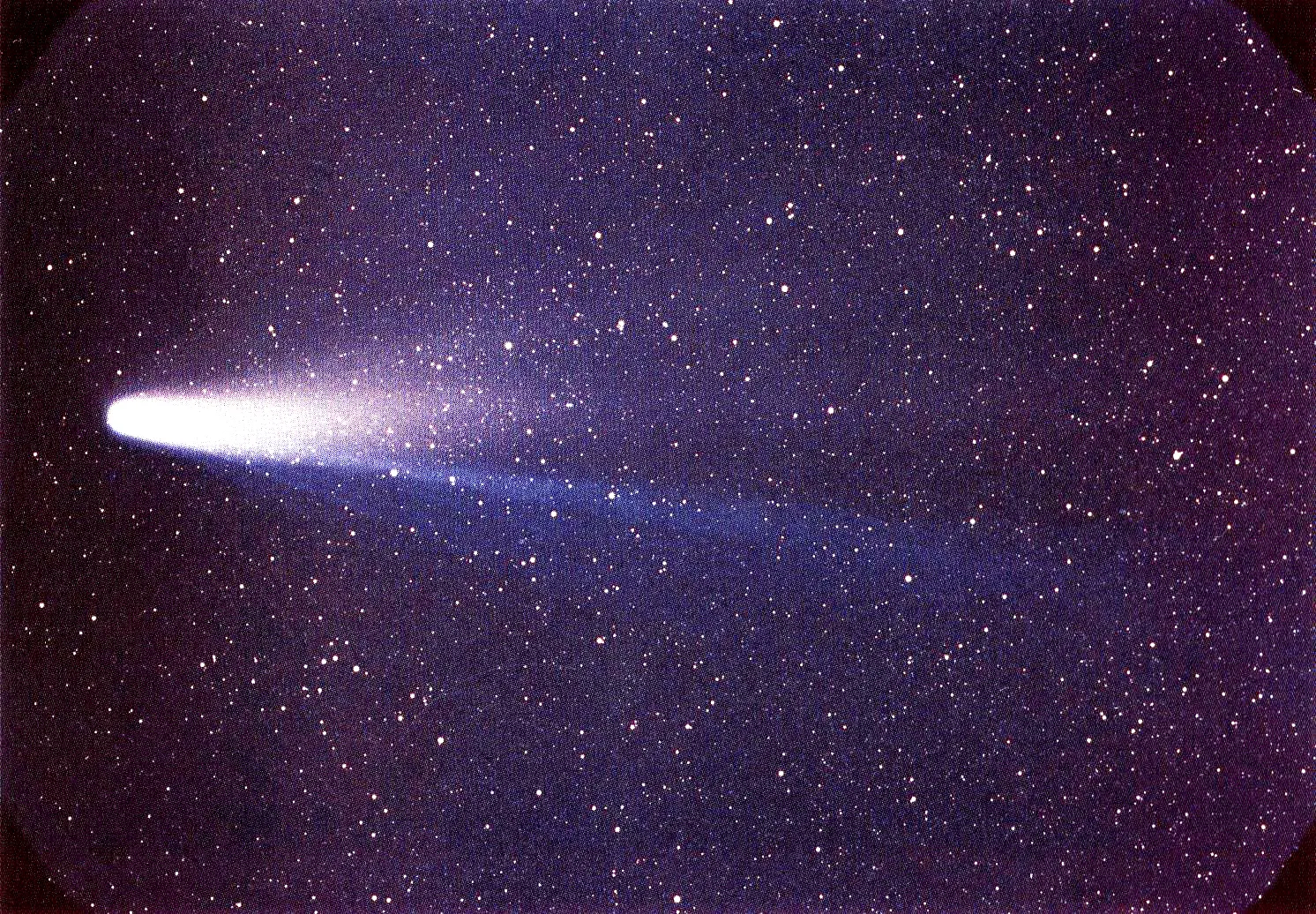
Halley’s Comet
Photo · NASA/W. Liller, public domain · source

About Halley’s Comet

Designation
1P/Halley
Type
Periodic comet
Discovered
1758-12-25
Nucleus diameter
11 km

Today

The most famous comet, recorded for more than 2,000 years. Edmond Halley showed that the comets of 1531, 1607 and 1682 were one object and predicted its return; Johann Palitzsch saw it again on 1758-12-25. It comes back about every 76 years: around its last perihelion, on 1986-02-09, the Vega 1 and 2, Suisei, Sakigake and Giotto probes flew past it, Giotto within 596 km of its 15 × 8 km nucleus. It returns in 2061, visible to the naked eye again; its dust causes the Eta Aquariid (May) and Orionid (October) meteor showers.

Questions and answers

When will Halley’s Comet come back?

In 2061, when it should again be visible to the naked eye; in 1986 five spacecraft flew past it, and Giotto photographed its nucleus.

Can I see pieces of Halley’s Comet today?

Yes: the dust it left along its orbit makes the Eta Aquariid shooting stars in May and the Orionids in October, when the Earth crosses that dust.

Where the numbers come from

Values refresh every second in your browser; the published data are checked every 10 minutes and updated several times a day.