Perigee FR

Where is Eunomia now?

Eunomia, the largest stony asteroid, gives its name to a whole family of asteroids born from an ancient collision; its live distance is computed below.

Live 3D view: Eunomia

Annibale de Gasparis discovered Eunomia in Naples on 29 July 1851. About 270 km across, elongated and irregular, it is the largest stony asteroid, of type S. It is also the largest member of a family. In the asteroid belt, a family is a group of asteroids whose orbits have nearly the same size, the same tilt and the same stretch, and whose surfaces have the same colours. They did not form that way by chance: long ago a violent collision broke a parent body, and its fragments went on around the Sun on neighbouring orbits. Eunomia is what remains of that parent. Families let astronomers look inside former asteroids, since their fragments show rock that was once deep within.
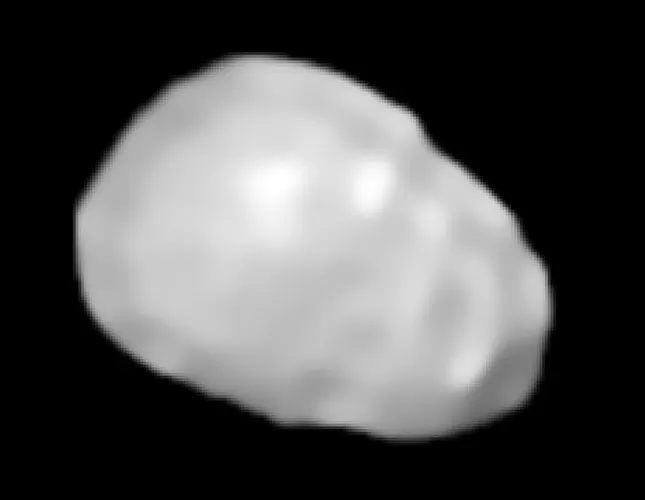
Eunomia
Telescope image · P. Vernazza et al. 2021 (A&A 654, A56), ESO VLT/SPHERE, CC BY 4.0 · source

About Eunomia

Designation
15 Eunomia
Group
Main asteroid belt
Mean diameter
270 km
Rotation period
6 h
Discovered
1851-07-29 (Annibale de Gasparis)

Today

The largest stony (S-type) asteroid, about 270 km across, elongated and irregular; it turns once every 6 hours and 5 minutes. Discovered by Annibale de Gasparis in Naples on 1851-07-29, it gives its name to the Eunomia family, one of the largest groups of asteroids sharing its orbit and composition, fragments of an ancient collision.

Questions and answers

What is a stony (S-type) asteroid?

An asteroid made mostly of silicate rock with some metal, brighter than the dark carbon-rich ones; most meteorites that fall on the Earth are of this kind of rock.

How long is a day on Eunomia?

It turns once on itself in about 6 hours and 5 minutes.

Where the numbers come from

Values refresh every second in your browser; the published data are checked every 10 minutes and updated several times a day.