Perigee FR

Where is the asteroid Didymos now?

Didymos is a near-Earth asteroid with a small moon, Dimorphos, which NASA’s DART spacecraft struck on purpose in 2022 to test how to deflect an asteroid; its live distance is computed below.

Live 3D view: Didymos

Didymos, Greek for “twin”, is a near-Earth asteroid about 770 m across with a small moon, Dimorphos, about 150 m across: a binary asteroid. From the Earth, the pair looks like a single point of light, but each time one body passes in front of the other, the light dips slightly. Timing those dips showed that Dimorphos went around Didymos in 11 hours 55 minutes. On 26 September 2022, NASA’s DART spacecraft crashed into Dimorphos on purpose while Italy’s LICIACube CubeSat photographed the impact. Telescopes then timed the dips again: the orbit had become about 32 minutes shorter. It was the first proof that a spacecraft can change the path of a natural body, and ESA’s Hera was sent to study the result up close.
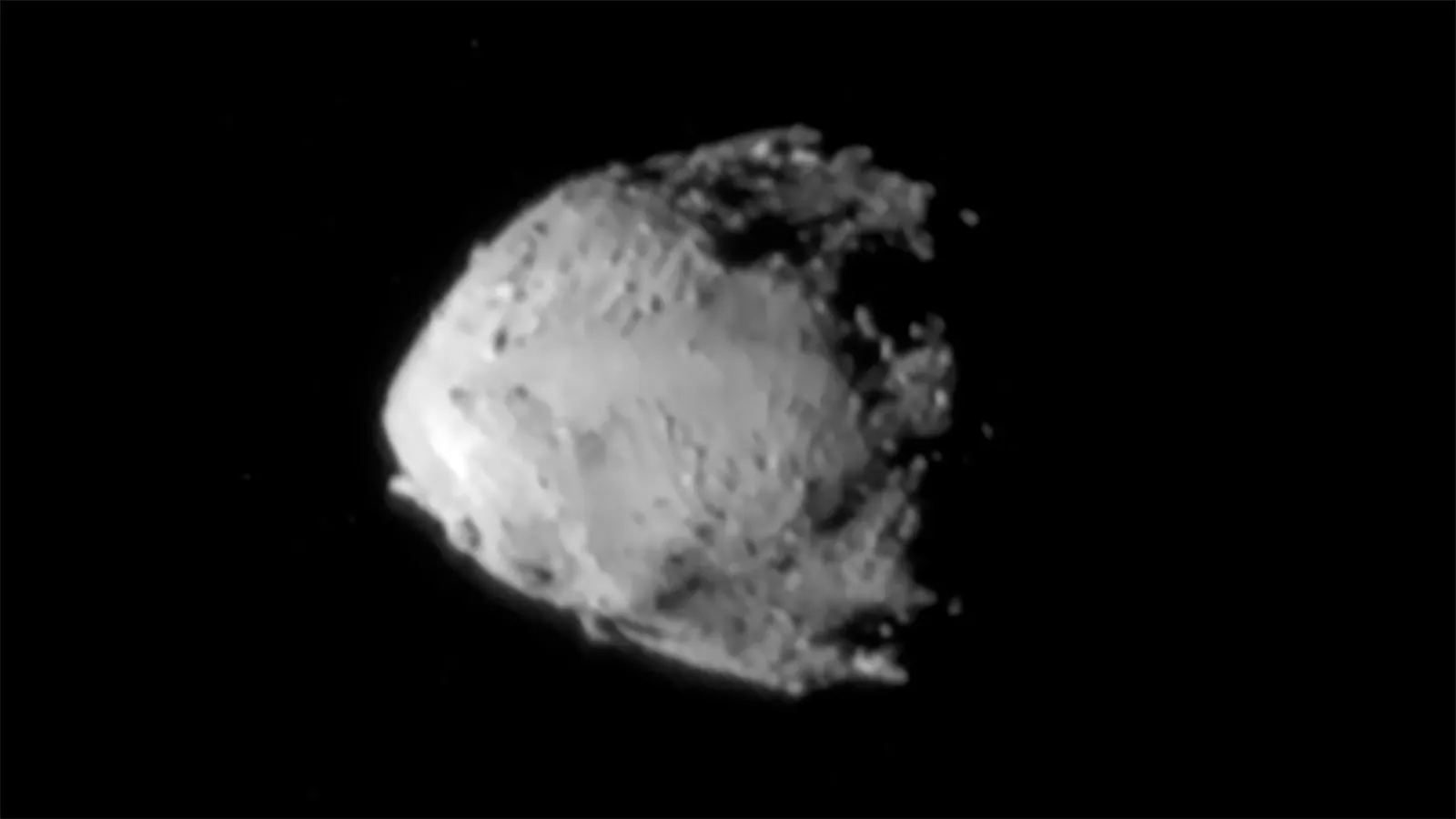
Didymos
Image taken by the spacecraft · NASA/Johns Hopkins APL, public domain · source

About Didymos

Designation
65803 Didymos
Group
Near-Earth asteroid
Mean diameter
1 km
Rotation period
2 h
Discovered
1996-04-11 (Spacewatch)

Today

A near-Earth asteroid about 770 m across with a small moon, Dimorphos, about 150 m across, which circled it in 11 hours 55 minutes. On 2022-09-26 NASA’s DART spacecraft struck Dimorphos on purpose and shortened its orbit by about 32 minutes: the first test of deflecting an asteroid. Italy’s LICIACube CubeSat photographed the impact; ESA’s Hera is due to survey the pair from late 2026.

Questions and answers

Why aim at the moon and not at Didymos?

A change in the moon’s orbit around Didymos shows within weeks by timing the dips in light, while a change in the pair’s path around the Sun would have been far too small to measure quickly.

Did DART put the Earth at risk?

No: the pair was chosen because its orbit does not threaten the Earth, and the impact only changed the moon’s motion around Didymos noticeably.

Where the numbers come from

Values refresh every second in your browser; the published data are checked every 10 minutes and updated several times a day.