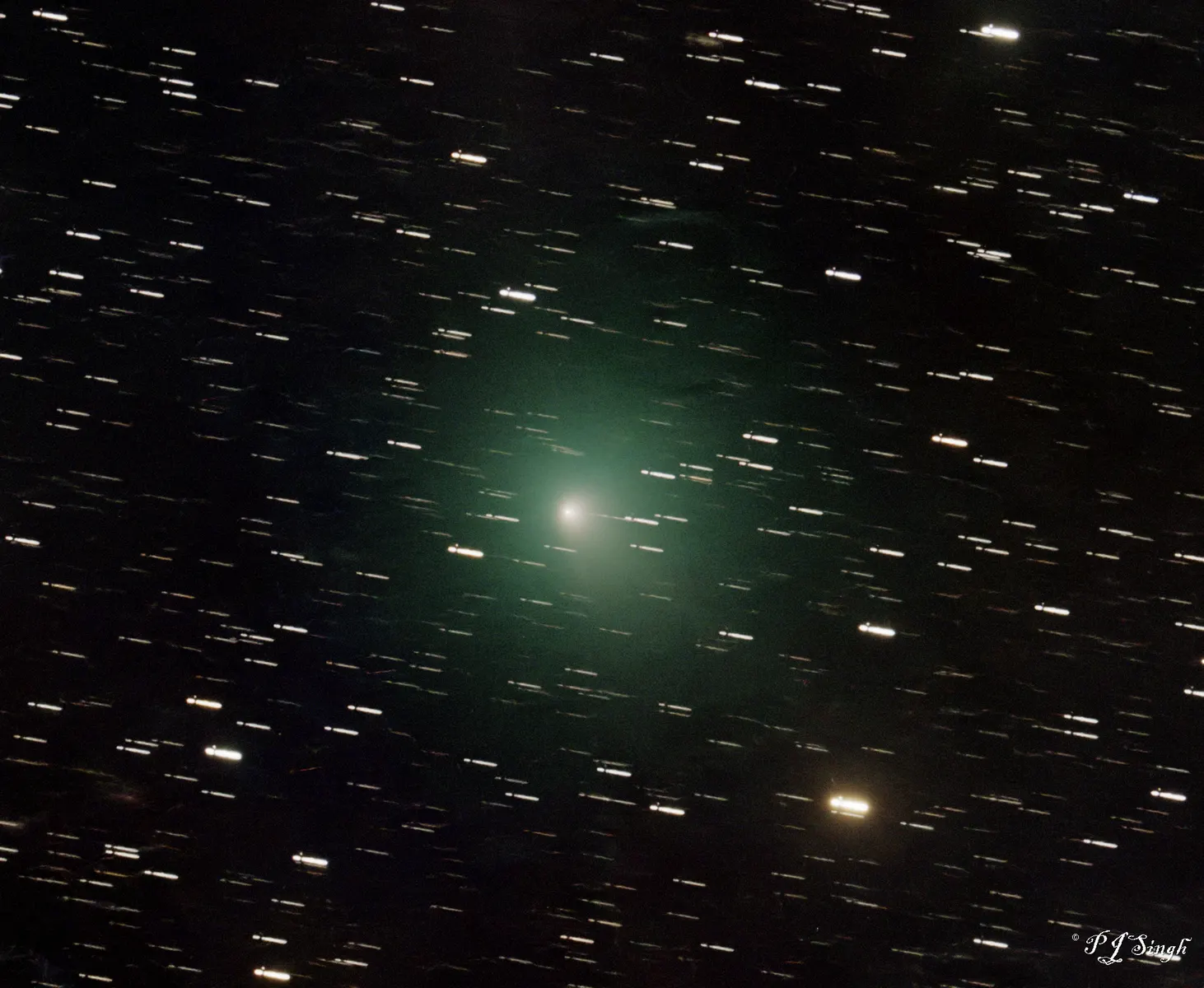
We picture comets as bright, but their nuclei are among the darkest objects known. Tempel 2, discovered by Wilhelm Tempel on 4 July 1873, has a very dark nucleus: like most comets, it reflects only a few per cent of the sunlight that falls on it, less than coal. The reason is a crust: each time the comet passes near the Sun, its surface ice turns to gas, but the heavier dust and dark, carbon-rich material stay behind and pile up, hiding the ice beneath. What makes a comet shine in the sky is not its nucleus but the cloud of gas and dust around it. Tempel 2 passed perihelion on 2 August 2026, 1.42 au from the Sun, and came within 0.41 au of the Earth the next day.