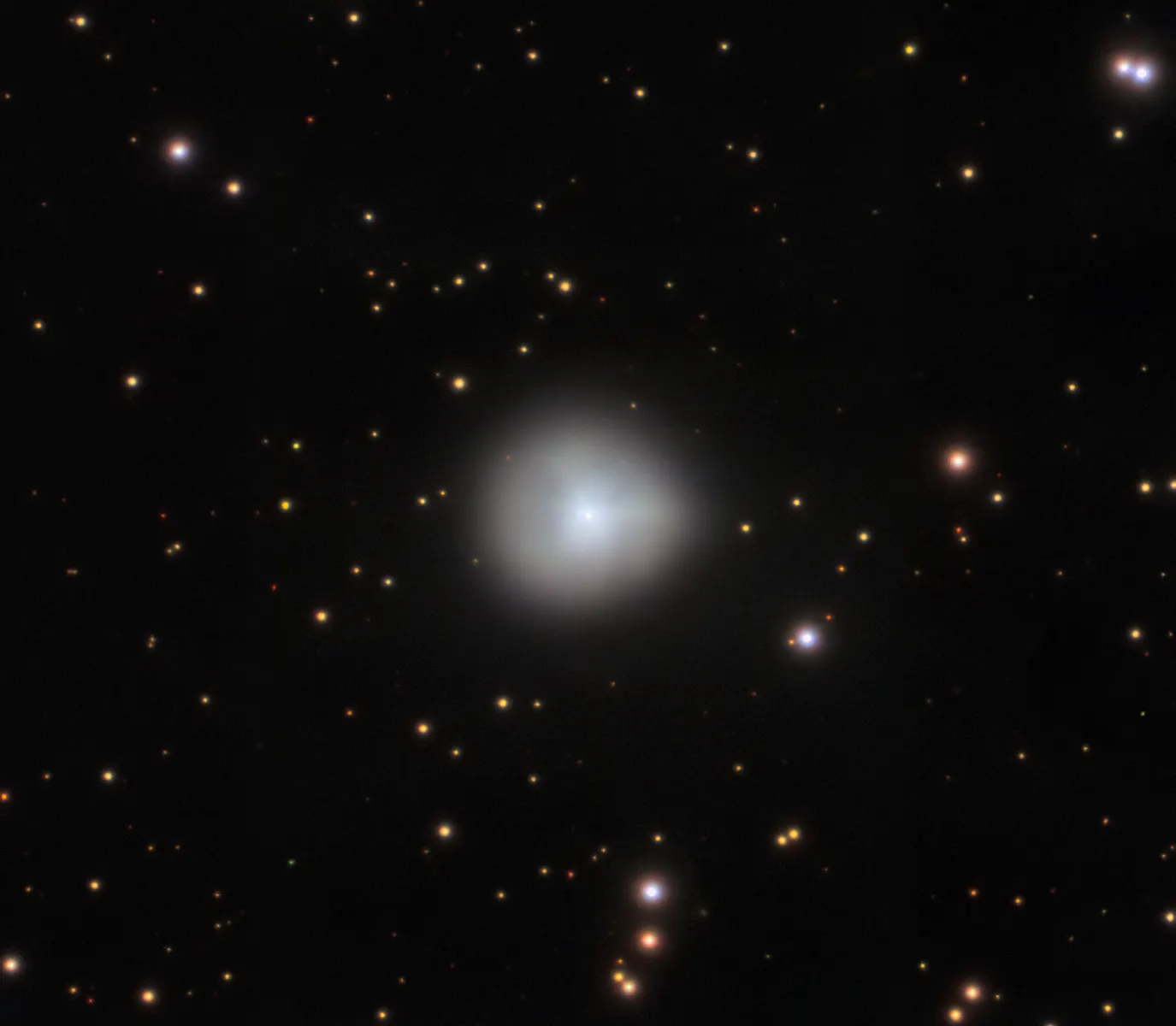
Comet Schwassmann-Wachmann 1 circles the Sun on a nearly round orbit just beyond Jupiter and flares up in sudden outbursts several times a year; its live distance is computed below.
Most comets follow very stretched orbits and wake up only when they come close to the Sun. Schwassmann-Wachmann 1, discovered at Hamburg Observatory in 1927, is different: its orbit is almost a circle, always between 5.8 and 6.3 times the Earth’s distance from the Sun, just beyond Jupiter. Water ice does not turn to gas that far out, in the cold, yet this comet is always active, so astronomers think other, more easily evaporated ices drive it. Several times a year it suddenly brightens by up to 5 magnitudes, a hundred times, within hours, then slowly fades. Its nucleus, about 60 km across, is one of the largest known. Astronomers see it as a body caught on its way from the outer solar system towards Jupiter’s family of comets.
Telescope image · International Gemini Observatory/NOIRLab/NSF/AURA/C. Schambeau; image processing: T.A. Rector, M. Zamani & D. de Martin, CC BY 4.0 · source
About Comet Schwassmann-Wachmann 1
Designation
29P/Schwassmann-Wachmann 1
Type
Periodic comet
Discovered
1927-11-15
Nucleus diameter
60 km
Today
Discovered at Hamburg Observatory on 1927-11-15 by Arnold Schwassmann and Arno Arthur Wachmann. Its nearly circular orbit keeps it just beyond Jupiter, 5.8 to 6.3 au from the Sun, which it circles every 14.9 years. Even that far out it is always active, and several times a year sudden outbursts brighten it by up to 5 magnitudes within hours from its usual magnitude 16. Its nucleus, about 60 km across, is one of the largest known; it is a telescope target.
Questions and answers
Can I see its outbursts?
With a telescope: it is usually around magnitude 16, and amateur astronomers watch it regularly to catch the next outburst.
What does 5 magnitudes mean?
The magnitude scale counts brightness backwards and in steps: 5 magnitudes less means exactly 100 times brighter.
Where the numbers come from
Values refresh every second in your browser; the published data are checked every 10 minutes and updated several times a day.