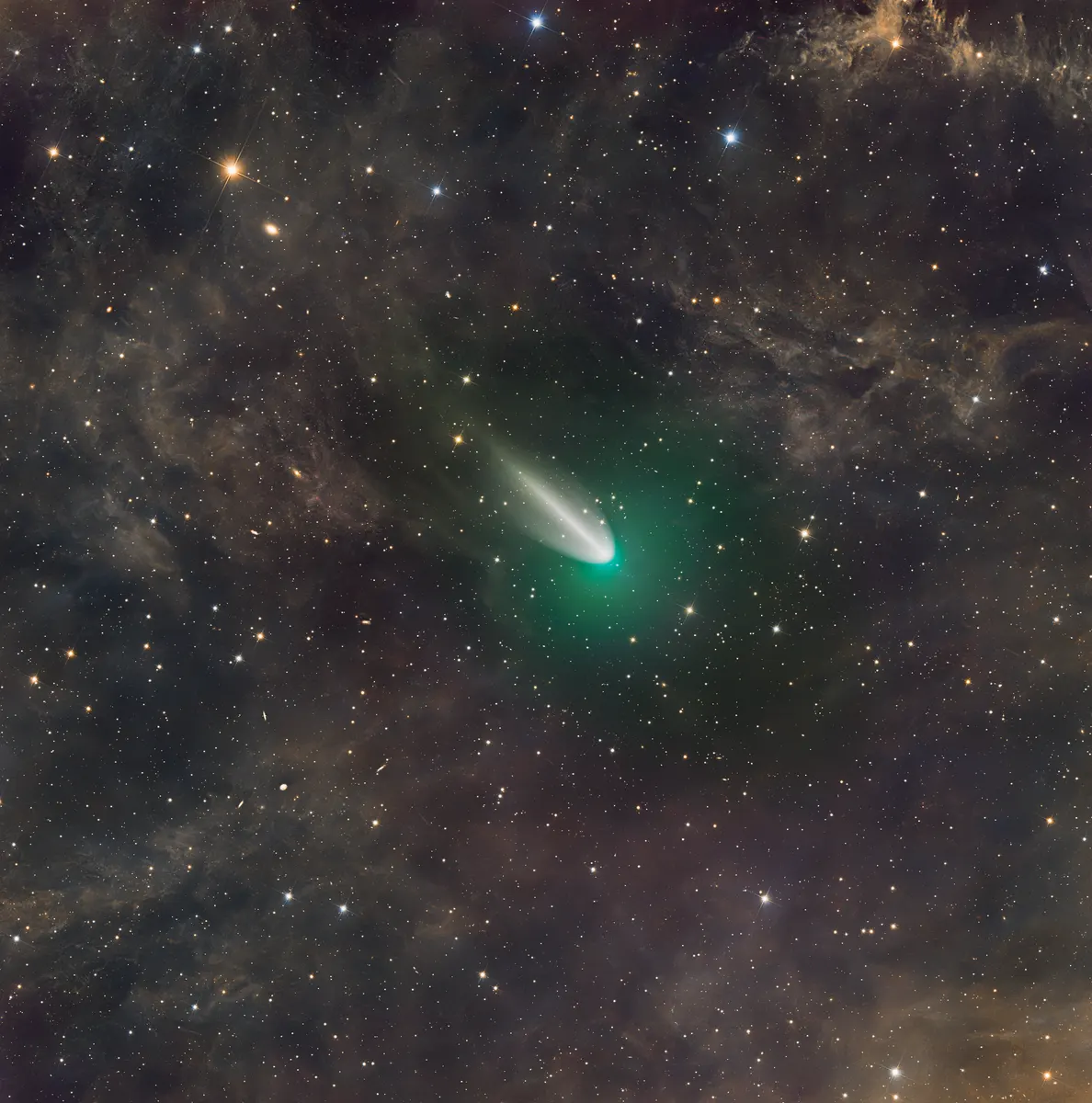
Robert McNaught, who found dozens of comets at Siding Spring Observatory in Australia, discovered this one on 20 May 2004; it goes around the Sun every 5.5 years. In 2026 it passed perihelion on 14 June, and outbursts in late May and on 5 August made it hundreds of times brighter for a while. Astronomers measure such jumps in magnitudes: each step of one magnitude is about 2.5 times in brightness, so 5 magnitudes are a factor of 100. An outburst does not mean the comet has grown: a small part of its surface gives way, releasing a cloud of fresh dust that reflects sunlight over a huge area, then spreads out and fades over days or weeks. The live view follows it as it moves away from the Sun.