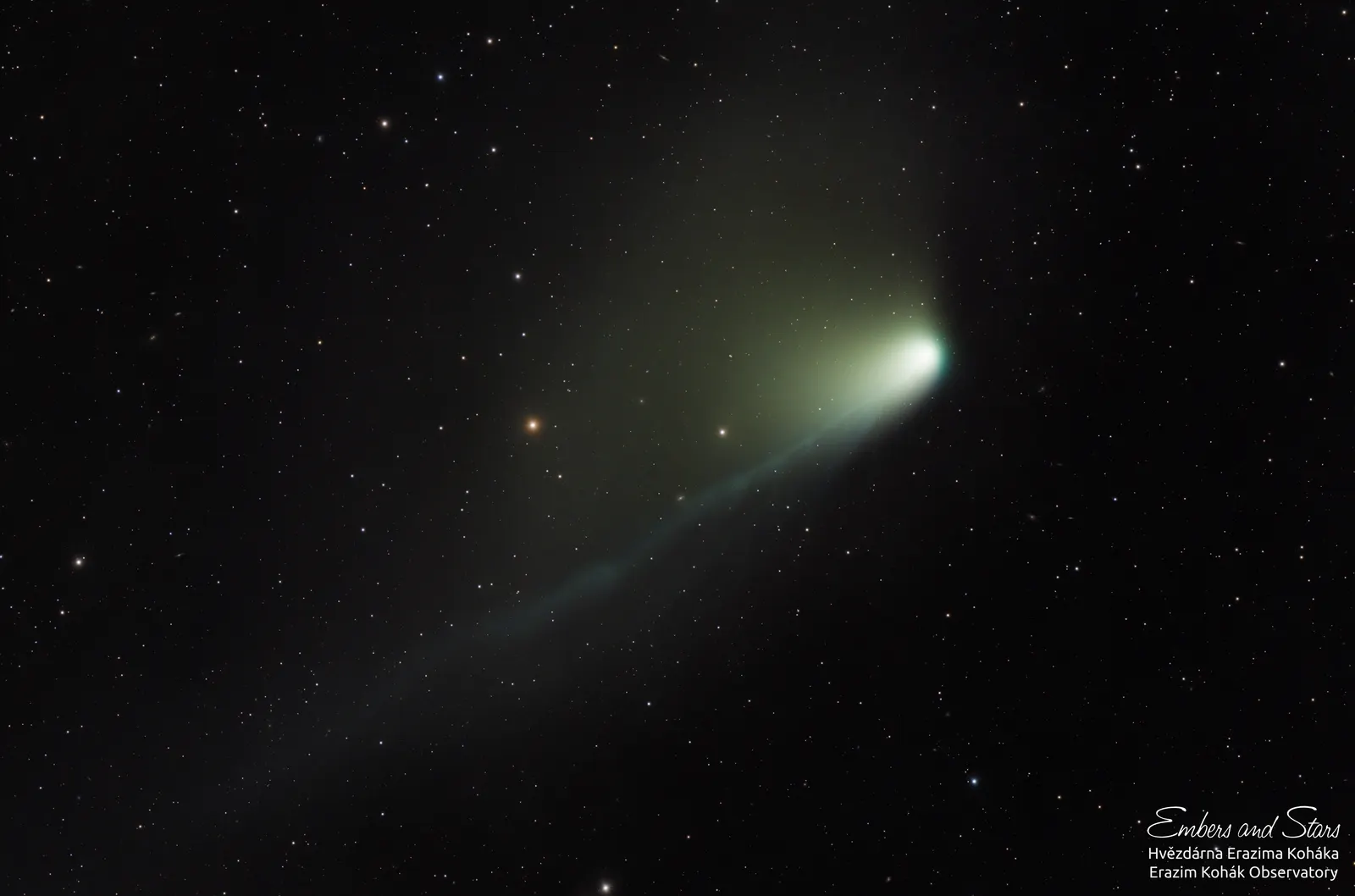
Heinrich Olbers, a German physician who observed the sky from his home in Bremen, discovered this comet on 6 March 1815; he is also known for Olbers’ paradox, the question of why the night sky is dark. His comet follows a long, stretched orbit and returns about every 70 years. Like every body around the Sun, it obeys Kepler’s laws: it moves fast when close to the Sun and slowly when far away. So it rushes through the inner solar system in a few months around perihelion, as it did around 30 June 2024, when it reached about magnitude 6 to 7, a binocular object, and then spends decades crawling through the cold, dark outer part of its orbit, beyond Neptune’s distance.