Perigee FR

Where is Comet Encke now?

Comet Encke has the shortest period of any known comet, going around the Sun every 3.3 years and coming closer to it than Mercury; its live distance is computed below.

Live 3D view: Comet Encke

Comet Encke was first seen by Pierre Méchain in 1786, but it was Johann Franz Encke who showed in 1819 that several comets seen since then were the same object, returning every 3.3 years. It was only the second comet, after Halley’s, whose return was predicted. Despite passing so close to the Sun so often, it is a fairly faint comet, usually a binocular or telescope target. The gas and dust it sheds spread along its whole orbit: when the Earth crosses this stream each year, the grains burn up in our atmosphere as the Taurid meteors of October and November, known for their slow, bright fireballs. Its next perihelion, its closest point to the Sun, falls on 10 February 2027.
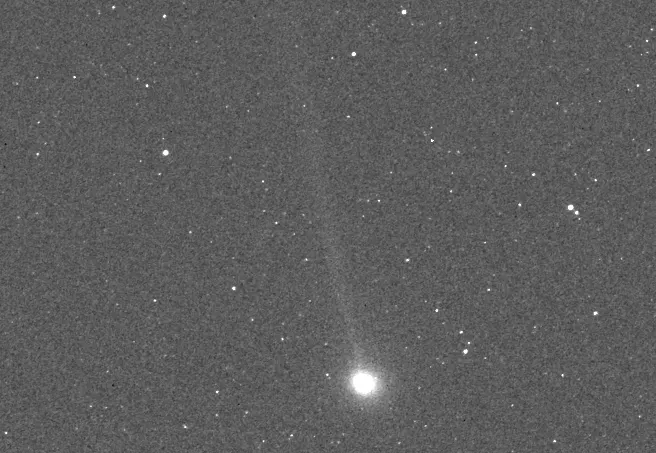
Comet Encke
Image taken by the spacecraft · NASA/JHU APL/Carnegie Institution of Washington, public domain · source

About Comet Encke

Designation
2P/Encke
Type
Periodic comet
Discovered
1786-01-17
Nucleus diameter
5 km

Today

The comet with the shortest known period: it goes around the Sun every 3.3 years, coming closer to it than Mercury. Discovered by Pierre Méchain on 1786-01-17, it is named after Johann Franz Encke, who computed its orbit in 1819. Its dust causes the Taurid meteor showers of October and November, known for their fireballs. Its next perihelion is on 2027-02-10; it is usually a binocular or telescope target.

Questions and answers

Why is a comet’s period so short?

Its orbit is small: at its farthest it does not go much beyond the asteroid belt, so a lap around the Sun is quick, like a planet close to the Sun.

What is a fireball?

A shooting star much brighter than usual, made by a larger grain or pebble burning up in the atmosphere.

Where the numbers come from

Values refresh every second in your browser; the published data are checked every 10 minutes and updated several times a day.