Perigee FR

Where is the asteroid Europa now?

The asteroid Europa, one of the largest of the main belt, is not Jupiter’s moon of the same name; its live distance is computed below.

Live 3D view: Europa

Hermann Goldschmidt, a painter who became an astronomer, discovered this asteroid from his balcony in Paris on 4 February 1858. About 319 km across and somewhat flattened, it is one of the largest asteroids. Astronomers sort asteroids by the colours of the sunlight they reflect, which reveal what their surface is made of. Europa is of type C: dark, rich in carbon compounds, reflecting only a small part of the light it receives. Type S asteroids are stony and brighter, type M ones may be metallic. C-type asteroids are thought to be among the least changed materials of the Solar System, close to the dark carbonaceous meteorites that sometimes fall on the Earth.
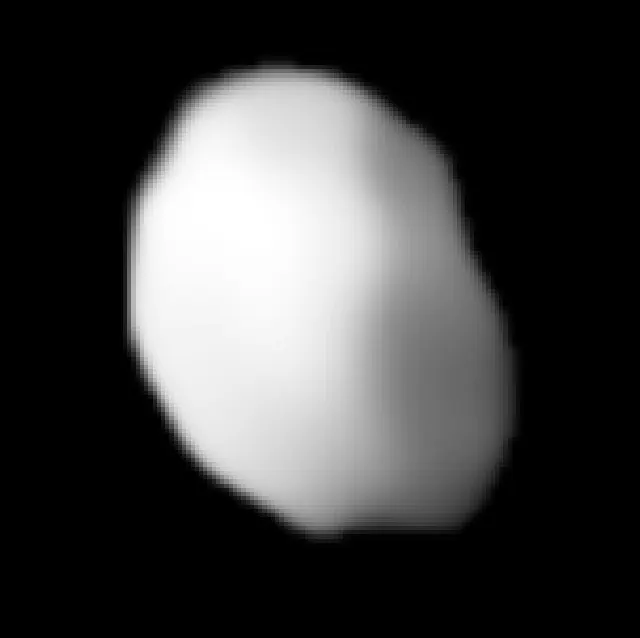
Europa
Telescope image · P. Vernazza et al. 2021 (A&A 654, A56), ESO VLT/SPHERE, CC BY 4.0 · source

About Europa

Designation
52 Europa
Group
Main asteroid belt
Mean diameter
319 km
Rotation period
6 h
Discovered
1858-02-04 (Hermann Goldschmidt)

Today

One of the largest asteroids, about 319 km across, dark and rich in carbon. Hermann Goldschmidt discovered it from his balcony in Paris on 1858-02-04. It shares its name with Jupiter’s moon Europa: both honour the same figure of Greek mythology.

Questions and answers

Why does this asteroid share its name with a moon of Jupiter?

Both honour the same figure of Greek mythology, Europa. To avoid confusion, astronomers write the asteroid’s number before its name: 52 Europa.

Has a spacecraft visited this asteroid?

No: it has only been studied with telescopes.

Where the numbers come from

Values refresh every second in your browser; the published data are checked every 10 minutes and updated several times a day.