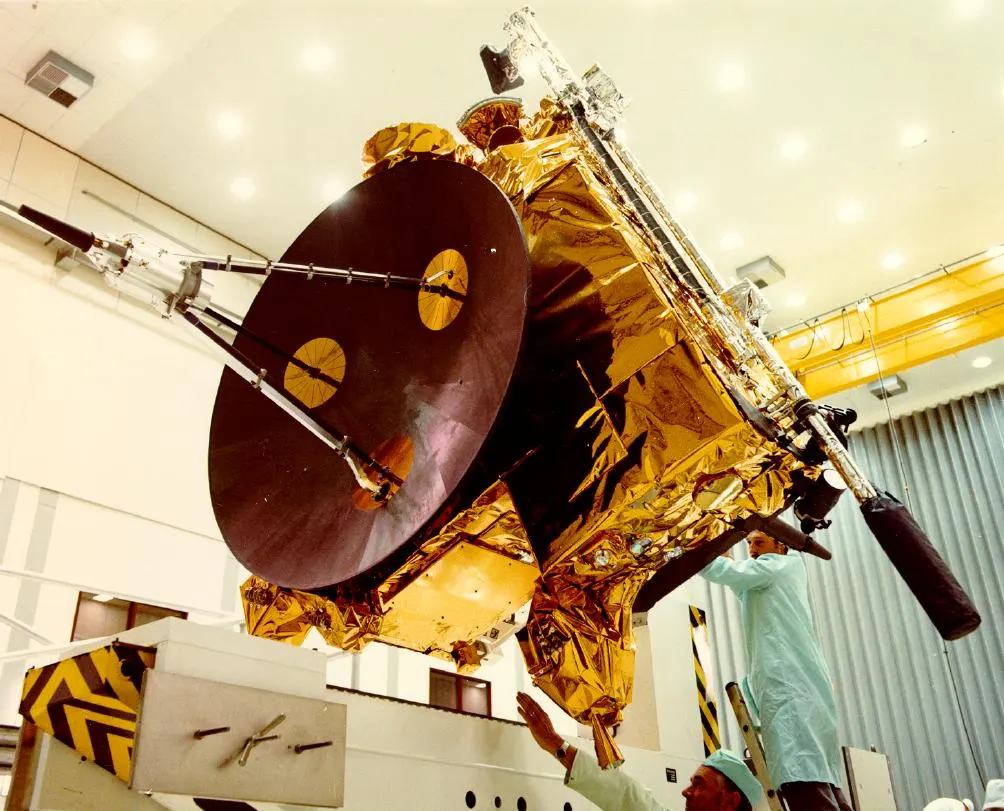
Ulysses, the first probe to fly over the Sun’s poles, was switched off in 2009 and still circles the Sun on a steeply tilted orbit; its live distance is computed below.
Ulysses, a joint ESA and NASA probe launched on 6 October 1990, studied the Sun from a place no spacecraft had reached: above its poles. The Earth and the planets all go round the Sun in nearly the same flat plane, and leaving that plane takes far more energy than a rocket can give. So Ulysses first flew to Jupiter, whose gravity, in 1992, tilted its orbit steeply. From then on it passed over the Sun’s south and north poles in turn, measuring the solar wind and the Sun’s magnetic field at every latitude. It found that the wind blows faster above the poles. Its nuclear power was running out, and it was switched off on 30 June 2009, after 18.6 years in space. The position shown is NASA/JPL’s predicted trajectory.
Ulysses, a joint ESA–NASA probe, was the first spacecraft to fly over the poles of the Sun, which cannot be seen well from Earth. A flyby of Jupiter in 1992 tilted its orbit steeply so that it could study the solar wind and the Sun's magnetic field at all latitudes. It showed that the solar wind blows faster above the poles and followed the Sun through almost two 11-year activity cycles.
Today
Controlled switch-off on 2009-06-30, after 18.6 years in space and well beyond its design life, as its nuclear power supply was running out. It keeps circling the Sun on its steeply inclined orbit, like an artificial comet. JPL Horizons publishes its predicted trajectory, so the position shown is a prediction, not a measurement.
No rocket could lift it out of the plane of the planets; Jupiter’s gravity did it for free, tilting its orbit so that it could pass over the Sun’s poles.
Is Ulysses still working?
No: it was switched off on 30 June 2009, well beyond its planned lifetime. It keeps circling the Sun over its poles, like an artificial comet.
Where the numbers come from
Values refresh every second in your browser; the published data are checked every 10 minutes and updated several times a day.