Perigee FR

Where is the asteroid Toutatis now?

Toutatis, an elongated near-Earth asteroid that tumbles instead of spinning, was visited by China’s Chang’e 2 in 2012; its live distance is computed below.

Live 3D view: Toutatis

Most asteroids spin around one axis, like a top. Toutatis does not: it tumbles, turning around one axis while that axis itself slowly swings around, so the asteroid never shows the same face in the same way twice. This elongated near-Earth asteroid, about 4.5 km long, was discovered by Christian Pollas at Caussols, in France, in 1989, and named after a Gaulish god, the one the heroes of the Asterix comics swear by. During its close passes, radar antennas on the Earth mapped its shape. Then China’s Chang’e 2, after finishing its work at the Moon, flew close past it on 13 December 2012 and photographed it: the first visit of an asteroid by a Chinese probe.
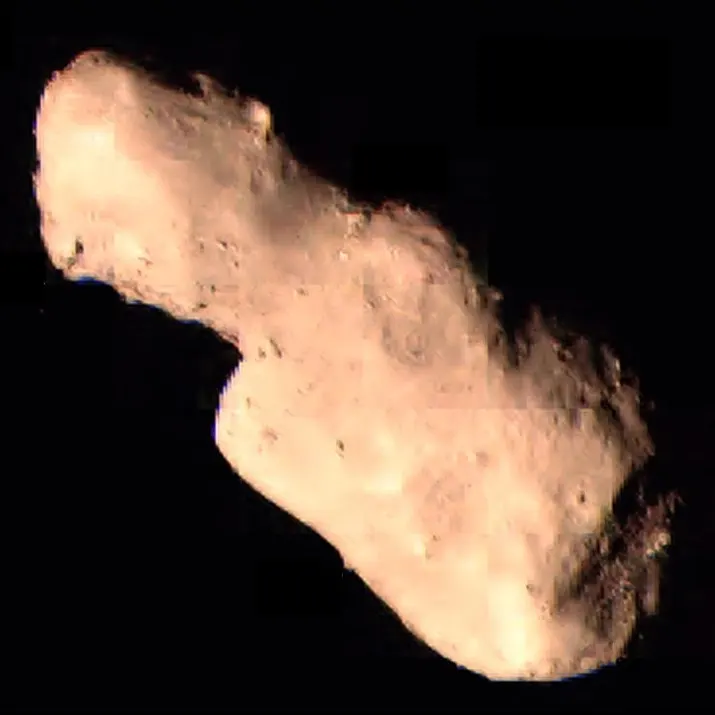
Toutatis
Image taken by the spacecraft · CNSA Chang'e 2; Y. Jiang, J. Ji et al. 2015 (Scientific Reports 5, 16029), CC BY 4.0 · source

About Toutatis

Designation
4179 Toutatis
Group
Near-Earth asteroid
Mean diameter
2 km
Discovered
1989-01-04 (Christian Pollas)

Today

An elongated near-Earth asteroid about 4.5 km long that tumbles slowly instead of spinning around one axis. Christian Pollas discovered it at Caussols, France, on 1989-01-04 and named it after a Gaulish god. Radar mapped it from Earth during its close passes, and China’s Chang’e 2, after leaving the Moon, flew close past it on 2012-12-13: the first Chinese probe to visit an asteroid.

Questions and answers

How can radar see an asteroid?

A large antenna sends radio waves towards it and records the echo; the delay and the change in pitch of the echo reveal its shape and how it turns.

Could Toutatis hit the Earth?

It passes fairly close from time to time, but its orbit is very well known and no impact is predicted.

Where the numbers come from

Values refresh every second in your browser; the published data are checked every 10 minutes and updated several times a day.