Perigee FR

Where is Sylvia now?

Sylvia, a large asteroid of the outer belt, was the first asteroid known to have two moons; its live distance is computed below.

Live 3D view: Sylvia

Norman Pogson discovered Sylvia at Madras, now Chennai in India, on 16 May 1866. It is a dark asteroid about 271 km across in the outer part of the belt. Its first moon, Romulus, was found in 2001, and a second, Remus, in 2005. Moons are precious to astronomers because they let them weigh the asteroid: the heavier it is, the faster a moon must travel to stay in orbit at a given distance. From the size and period of a moon’s orbit, Kepler’s laws give the asteroid’s mass. Dividing it by Sylvia’s volume gives a surprisingly low density, which suggests a porous body, perhaps a pile of rubble with empty spaces inside.
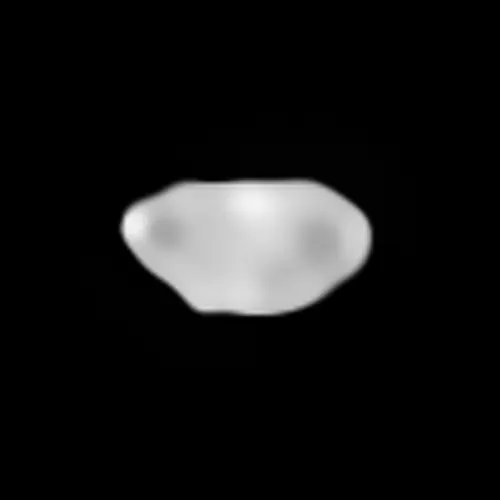
Sylvia
Telescope image · ESO/Vernazza et al./MISTRAL algorithm (ONERA/CNRS), CC BY 4.0 · source

About Sylvia

Designation
87 Sylvia
Group
Main asteroid belt
Mean diameter
271 km
Rotation period
5 h
Discovered
1866-05-16 (Norman Robert Pogson)

Today

A dark asteroid about 271 km across, orbiting in the outer belt with the Cybele group. It was the first asteroid known to have two moons: Romulus, found in 2001, and Remus, announced in 2005. Norman Pogson, who discovered it at Madras (now Chennai, India) on 1866-05-16, named it after Rhea Silvia, the mother of the twins Romulus and Remus.

Questions and answers

Why are its moons called Romulus and Remus?

Sylvia is named after Rhea Silvia, who in Roman legend was the mother of the twins Romulus and Remus, the founders of Rome.

Can we see Sylvia’s moons?

Only with the largest telescopes, as faint dots next to the asteroid; they are far too small and close to it for amateur instruments.

Where the numbers come from

Values refresh every second in your browser; the published data are checked every 10 minutes and updated several times a day.