Pallas, the second asteroid ever discovered, follows an orbit steeply tilted to the plane of the planets; its live distance is computed below.
Heinrich Olbers found Pallas on 28 March 1802, a year after Ceres, while astronomers were searching for a missing planet between Mars and Jupiter. About 511 km across, it is one of the three largest bodies of the asteroid belt. What sets it apart is its orbit: the planets travel around the Sun in almost the same flat plane, but Pallas’s path is tilted by about 35°, so it climbs far above that plane and then dives far below it. A spacecraft launched from the Earth starts out in the plane of the planets, and changing the tilt of its path takes an enormous amount of fuel. That is why no probe has ever visited Pallas, which we know only through telescopes.
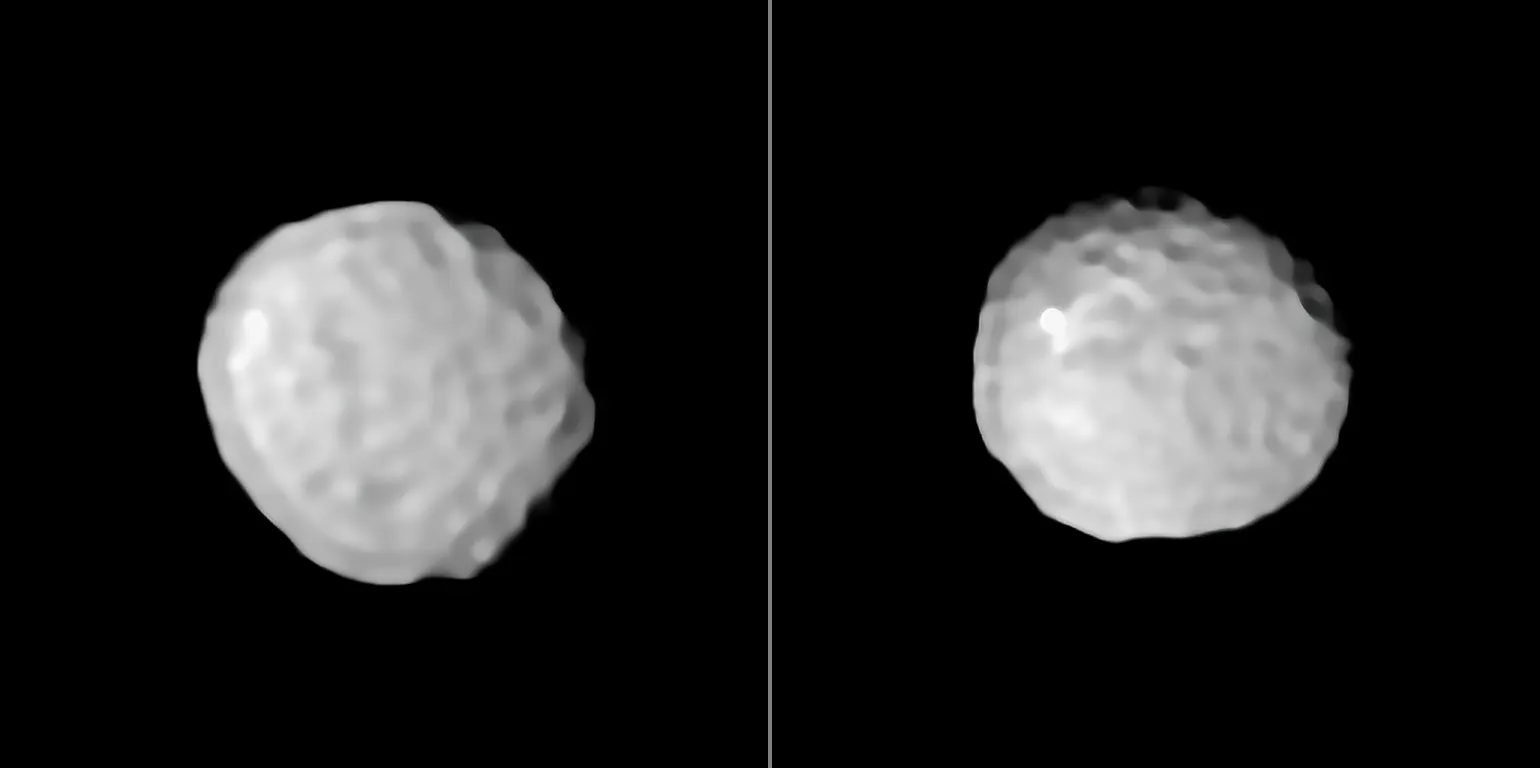
Telescope image · ESO/M. Marsset, P. Vernazza et al./MISTRAL algorithm (ONERA/CNRS), CC BY 4.0 · source
About Pallas
Designation
2 Pallas
Group
Main asteroid belt
Mean diameter
511 km
Rotation period
8 h
Discovered
1802-03-28 (Heinrich Wilhelm Olbers)
Today
The second asteroid ever discovered, by Heinrich Olbers on 1802-03-28, and the third-largest body of the asteroid belt. Its orbit is tilted by about 35° to the plane of the planets, which makes it hard to reach: no spacecraft has visited it. Images from ESO’s Very Large Telescope show a surface riddled with large craters, which earned it the nickname “golf ball asteroid”.
Questions and answers
Why is Pallas called the “golf ball asteroid”?
Images from ESO’s Very Large Telescope show its surface pitted with large craters, like the dimples of a golf ball.
Has any spacecraft flown past Pallas?
No: everything we know about it comes from telescopes, on the ground and in space.
Where the numbers come from
Values refresh every second in your browser; the published data are checked every 10 minutes and updated several times a day.