Perigee FR

Where is the asteroid Mathilde now?

Mathilde, a dark, carbon-rich main-belt asteroid about 66 km long, was visited by NASA’s NEAR Shoemaker in 1997; its live distance is computed below.

Live 3D view: Mathilde

On 27 June 1997, NASA’s NEAR Shoemaker, on its way to Eros, flew past Mathilde. The asteroid is very dark, reflecting only a few percent of the sunlight, because it is rich in carbon. As the probe went by, Mathilde’s gravity bent its path very slightly, and that bend gave the asteroid’s mass. Dividing the mass by the volume gave a surprise: Mathilde is only a little denser than water, much less than solid rock. It must be full of empty spaces, perhaps a pile of rubble held together by its own gravity. That would also explain its giant craters, almost as wide as Mathilde itself: a porous body absorbs a blow like foam instead of shattering.
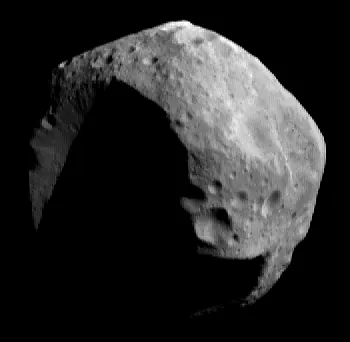
Mathilde
Image taken by the spacecraft · NASA/JHU APL (NEAR), public domain · source

About Mathilde

Designation
253 Mathilde
Group
Main asteroid belt
Mean diameter
53 km
Rotation period
418 h
Discovered
1885-11-12 (Johann Palisa)

Today

NASA’s NEAR Shoemaker flew past it on 1997-06-27, on its way to Eros. Mathilde is very dark and rich in carbon, with craters almost as wide as itself, and its low density shows that it is porous, perhaps a pile of rubble. It turns very slowly, once every 17.4 days.

Questions and answers

Why does Mathilde turn so slowly?

Nobody knows for sure. It takes about 17.4 days to turn once, while most asteroids of its size turn in a few hours.

Who was Mathilde?

Johann Palisa discovered the asteroid from Vienna in 1885; it is thought to be named after Mathilde Loewy, the wife of an astronomer of the Paris Observatory.

Where the numbers come from

Values refresh every second in your browser; the published data are checked every 10 minutes and updated several times a day.