NASA’s IMAP orbits near the Sun–Earth L1 point, from where it maps the edge of the Sun’s bubble in space; its live distance is computed below.
IMAP, the Interstellar Mapping and Acceleration Probe, was launched on 24 September 2025 with two other spacecraft, Carruthers and SWFO-L1, and reached its orbit around the Sun–Earth L1 point in January 2026. The Sun blows a wind of charged particles that inflates a giant bubble around the solar system, the heliosphere; where it meets the gas between the stars lies its frontier, which only the two Voyagers have crossed. IMAP maps that distant edge without going there: it catches neutral atoms that fly straight back from the frontier, like light from a distant object, and builds images from them. It also studies how the Sun speeds up particles and sends real-time solar wind data that improve space-weather forecasts.
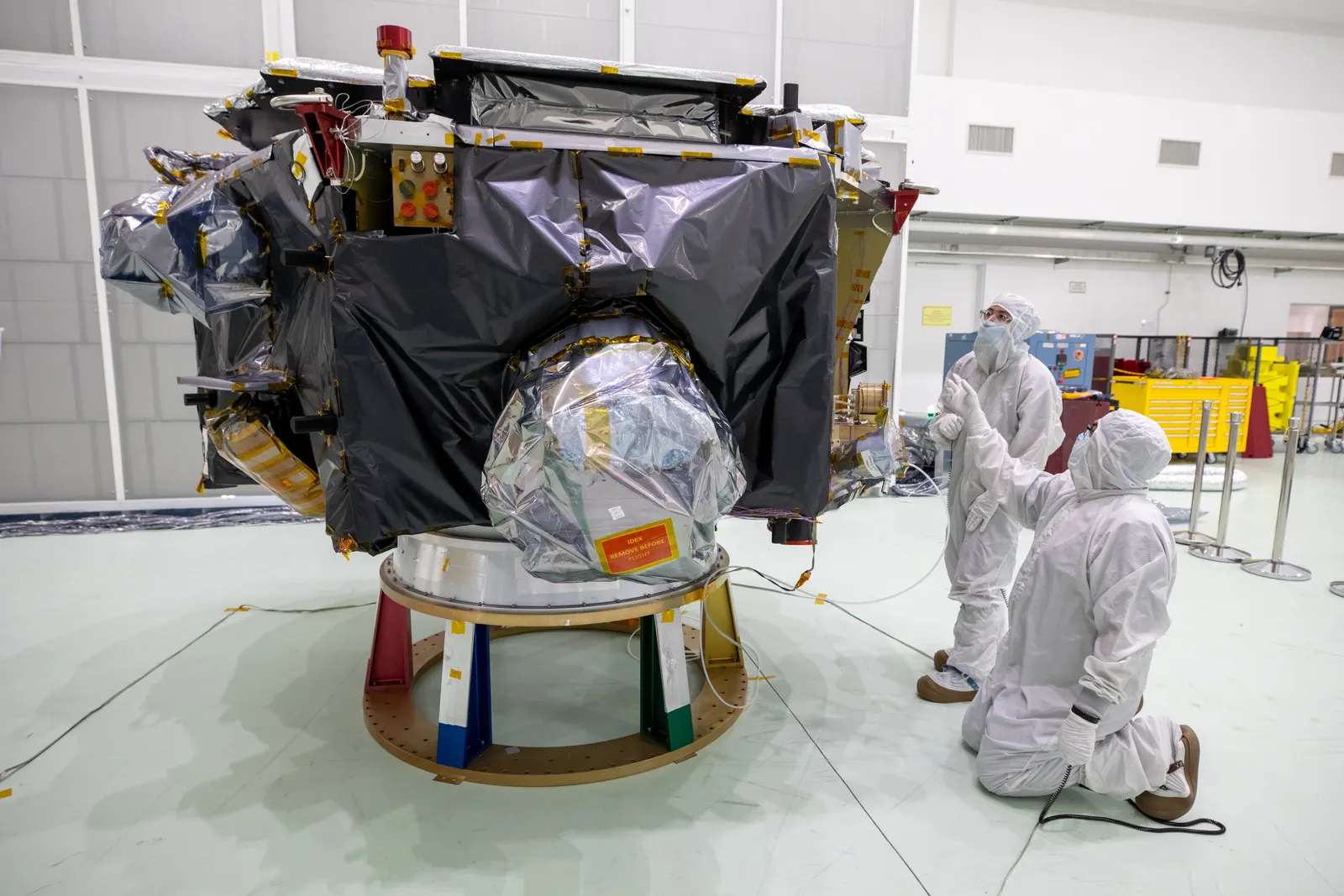
Photo · NASA/Amber Jean Notvest, public domain · source
About IMAP
Agency
NASA
Launched
2025-09-24
Status
Active
Goals
IMAP maps the heliosphere, the giant bubble blown by the solar wind around the solar system, and its boundary with interstellar space, by catching neutral atoms that fly in from that frontier. It also studies how the Sun accelerates particles and measures interstellar dust. From its post near Sun–Earth L1 it sends real-time solar wind data that improve space-weather forecasts.
Today
Entered final L1 orbit 2026-01-10; science mission began 2026-02-01. Maps the heliosphere boundary. All 10 instruments collecting data; as of August 2026, science data from 7 of them has been released. Launched with Carruthers and SWFO-L1.
Charged particles are steered by magnetic fields and lose track of where they came from; neutral atoms travel in straight lines, so their direction points back to their place of origin.
Why does the heliosphere matter?
It shields the planets from much of the cosmic radiation coming from the rest of the galaxy.
Where the numbers come from
Values refresh every second in your browser; the published data are checked every 10 minutes and updated several times a day.