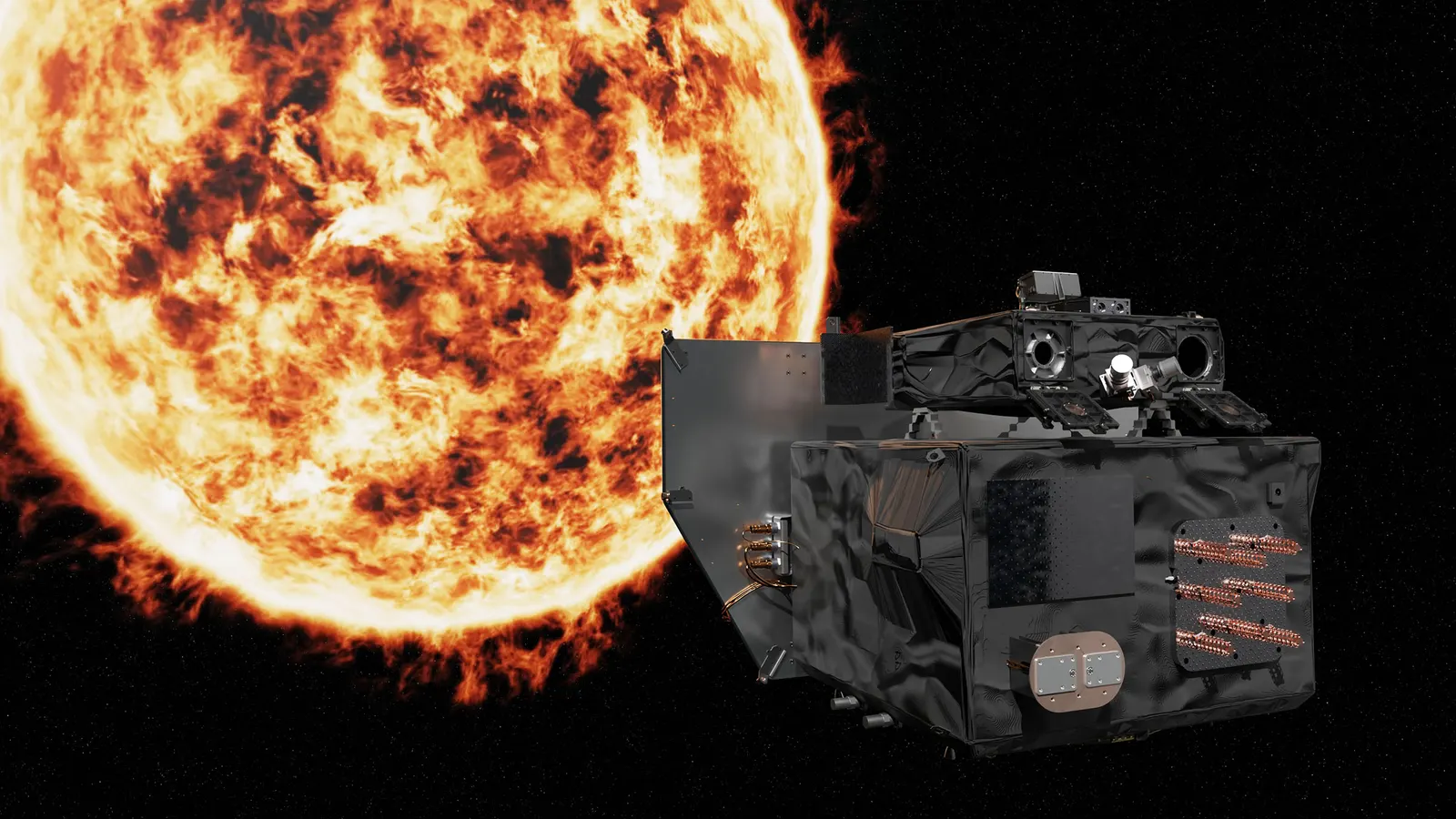
NASA’s Carruthers Geocorona Observatory looks back at the Earth from around the L1 point, to photograph the faint glow of its outermost atmosphere; its live distance is computed below.
Carruthers was launched on 24 September 2025 with IMAP and reached its orbit around the Sun–Earth L1 point in January 2026. Unlike its neighbours, it does not look at the Sun: it turns around to watch the Earth. Our atmosphere does not stop at a sharp edge. Its outermost layer, the exosphere, is a thin cloud of hydrogen atoms that reaches far into space and glows faintly in ultraviolet light; this glow is called the geocorona. Only from far away can the whole cloud be seen at once. Carruthers measures its shape, size and density, how solar storms reshape it, and how hydrogen from water vapour low in the atmosphere climbs so high. Its main mission runs until about March 2028.
Carruthers studies the exosphere, the outermost layer of Earth's atmosphere, made of hydrogen that glows faintly in ultraviolet light (the geocorona). Watching the whole Earth from far away, it measures the shape, size and density of this layer, how solar storms reshape it, and how hydrogen from water vapour low in the atmosphere reaches such extreme altitudes.
Today
Reached L1 orbit 2026-01-08; 24-month primary mission started 2026-03-01 (to ~March 2028). Images Earth's hydrogen exosphere in ultraviolet.
George Carruthers, an American scientist who built the ultraviolet camera that Apollo 16 astronauts set up on the Moon in 1972; it took the first pictures of the geocorona from afar.
Can we see the geocorona with our eyes?
No: it shines only in ultraviolet light, which our eyes cannot see and which the lower atmosphere absorbs.
Where the numbers come from
Values refresh every second in your browser; the published data are checked every 10 minutes and updated several times a day.