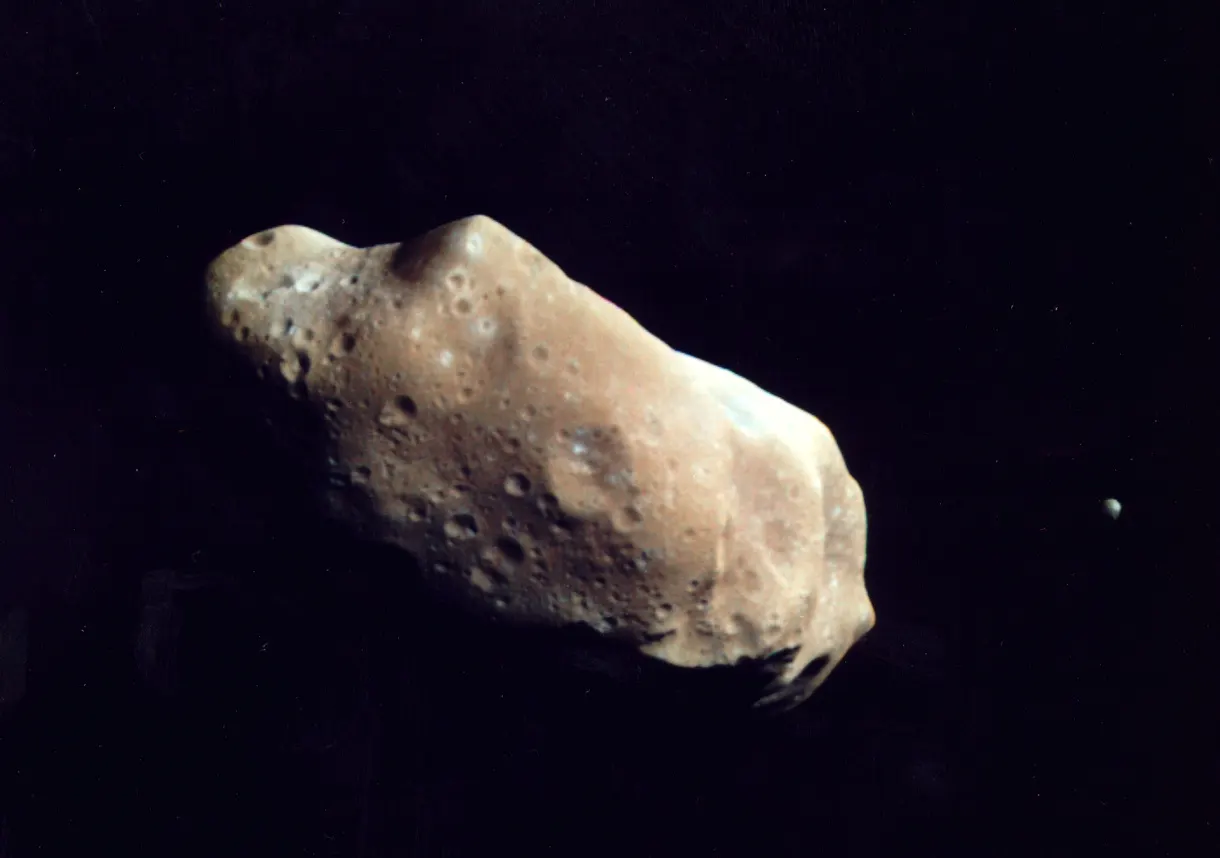
Ida, a stony main-belt asteroid about 60 km long, is the first asteroid found to have a moon, Dactyl, seen by NASA’s Galileo in 1993; its live distance is computed below.
On its way to Jupiter, NASA’s Galileo flew past Ida on 28 August 1993. Months later, as its pictures slowly reached the Earth, scientists noticed a tiny companion about 1.4 km across: Dactyl, the first moon ever found around an asteroid. A moon is a precious tool. How fast it circles depends on the mass of the body it orbits, so by following Dactyl scientists could weigh Ida; dividing that mass by Ida’s volume gave its density, a clue to what it is made of. Since then, telescopes and spacecraft have found moons around many other asteroids. Ida itself was discovered by Johann Palisa from Vienna in 1884.
Image taken by the spacecraft · NASA/JPL, public domain · source
About Ida
Designation
243 Ida
Group
Main asteroid belt
Mean diameter
31 km
Rotation period
5 h
Discovered
1884-09-29 (Johann Palisa)
Today
NASA’s Galileo flew past this stony asteroid, about 60 km long, on 1993-08-28 on its way to Jupiter. Its images revealed Dactyl, a moon about 1.4 km across: the first moon ever found around an asteroid. Ida was discovered by Johann Palisa in Vienna on 1884-09-29.
Questions and answers
Where does the name Dactyl come from?
In Greek myth, the Dactyls were small beings who lived on Mount Ida: a fitting name for the little companion of Ida.
How small is Dactyl next to Ida?
Very: about 1.4 km across against about 60 km long for Ida. If Ida were a car, Dactyl would be a ball about 10 cm wide.
Where the numbers come from
Values refresh every second in your browser; the published data are checked every 10 minutes and updated several times a day.