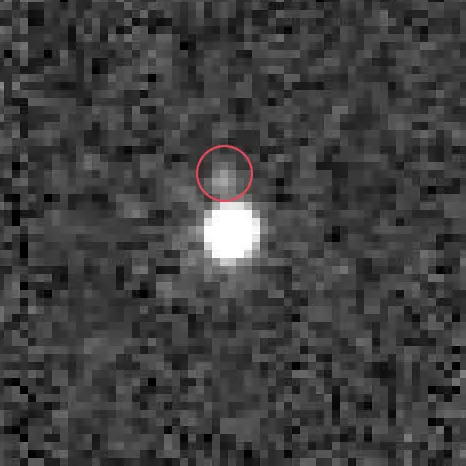
Gonggong, a dwarf planet candidate of the scattered disc beyond Neptune, takes about 550 years to go around the Sun; its live distance is computed below.
How big is a dot of light billions of kilometres away? Its brightness alone cannot say: a small, shiny body and a large, dark one can look the same. Astronomers solved this for Gonggong by also measuring its heat glow in infrared light: a dark surface absorbs more sunlight and glows warmer, so combining both measurements gives the size and the darkness. Gonggong is about 1,230 km across, one of the largest bodies beyond Neptune, with a reddish surface holding water ice and methane. It is a dwarf planet candidate: it is probably round, but the International Astronomical Union has not recognised it. Its stretched orbit takes it from 33 to 101 times the Earth’s distance from the Sun.
Telescope image · NASA, STScI, W. Fraser, G. Marton et al. (Hubble), public domain · source
About Gonggong
Status
Active
Today
One of the largest bodies beyond Neptune, about 1,230 km across (measured from its heat glow). Its reddish surface holds water ice and methane, and it turns slowly, in 22 hours. Named in 2020 after a Chinese water god; its moon Xiangliu was found in Hubble images.
Questions and answers
Where does the name Gonggong come from?
From a Chinese water god; the name was given in 2020. Its moon, found in Hubble images, is named Xiangliu, after a nine-headed serpent that served him.
Why is Gonggong not an official dwarf planet?
To be one, a body must be shown to be round; that is hard to prove for something so far away, so it stays a candidate, like Quaoar, Orcus and Sedna.
Where the numbers come from
Values refresh every second in your browser; the published data are checked every 10 minutes and updated several times a day.