Perigee FR

Where is Quaoar now?

Quaoar, a dwarf planet candidate of the Kuiper Belt, goes around the Sun in about 284 years on a nearly circular orbit; its live distance is computed below.

Live 3D view: Quaoar

Quaoar, about 1,100 km across, was discovered in 2002 by Chad Trujillo and Mike Brown and named after the creator deity of the Tongva people of the Los Angeles area. It is a dwarf planet candidate, not yet recognised by the International Astronomical Union. Its surprise came when it passed in front of stars: the starlight dimmed briefly well before and after the body itself, revealing two thin rings. That was unexpected. Close to a body, its tides pull apart clumps of material, so they spread into rings; farther out, the clumps should gather into a moon. Quaoar’s rings lie much farther out than that limit, and astronomers are still working out how they survive. Its moon, Weywot, may help keep them in place.
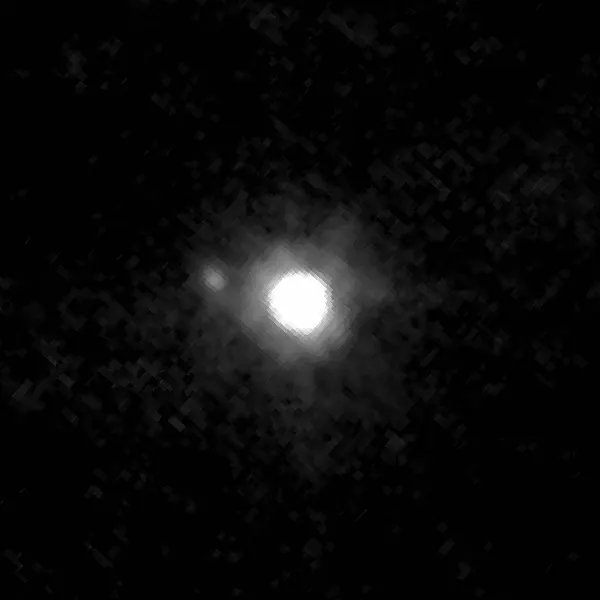
Quaoar
Telescope image · E. Fernandez-Valenzuela (Hubble, STScI/NASA), processed by Nrco0e, CC BY 4.0 · source

About Quaoar

Status
Active

Today

About 1,100 km across, sized precisely when it passed in front of stars (occultations). Those occultations also revealed two thin rings far from the body, much farther out than rings were thought to survive. Its moon is Weywot.

Questions and answers

How do you find rings around such a distant body?

By watching it pass in front of a star, an occultation: the star blinks out for a moment each time a ring crosses it, and telescopes in several places map them.

Do other dwarf planets have rings?

Yes: a ring was found around Haumea in 2017, also during an occultation. Rings around small bodies were thought impossible before the 2010s.

Where the numbers come from

Values refresh every second in your browser; the published data are checked every 10 minutes and updated several times a day.