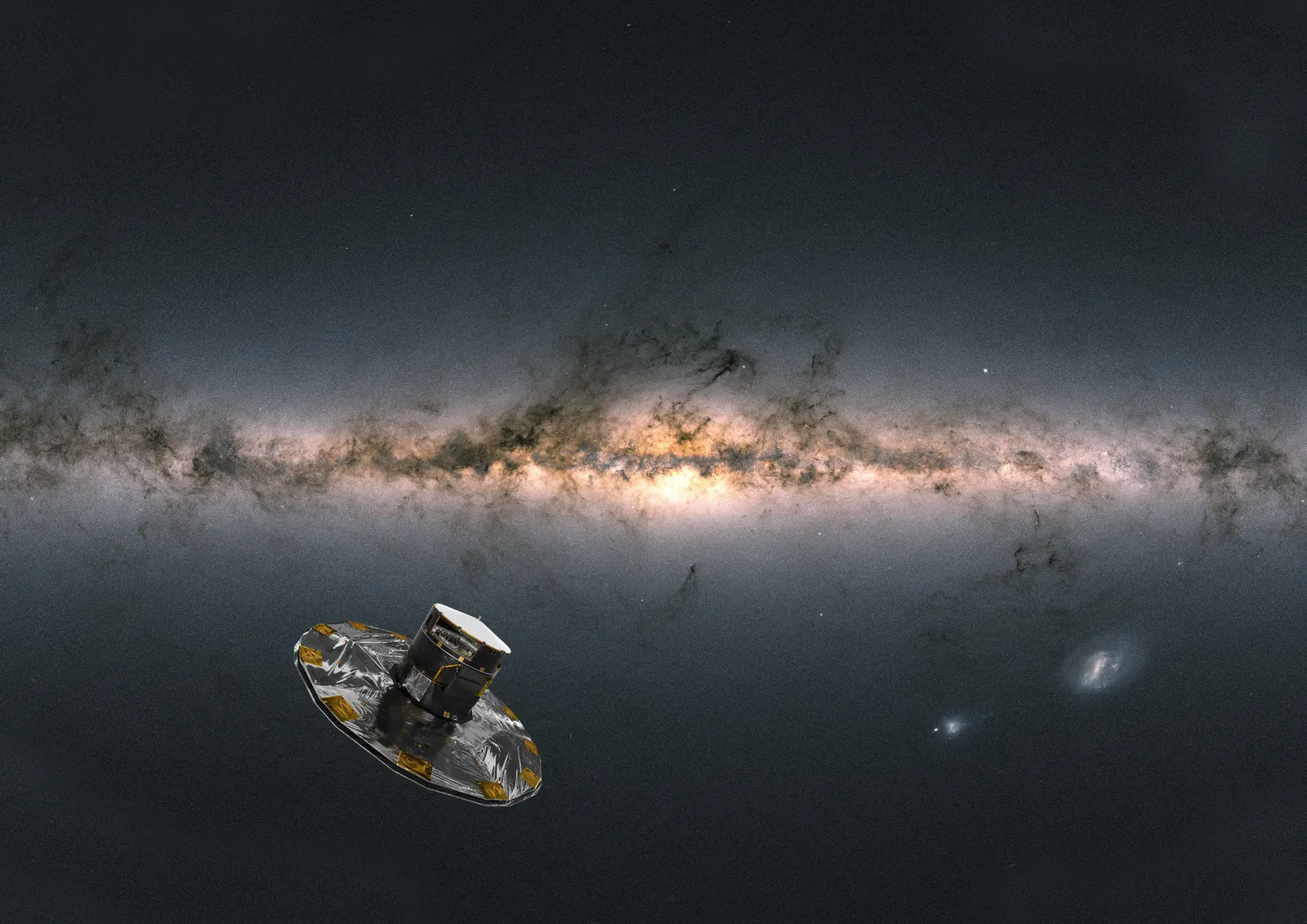
ESA’s Gaia, which mapped nearly two billion stars of the Milky Way, was retired in 2025 on an orbit around the Sun far from the Earth; its live distance is computed below.
Gaia, a European Space Agency spacecraft launched on 19 December 2013, worked from the Sun–Earth L2 point to build the most precise three-dimensional map of our galaxy. To find how far a star is, it used parallax: as Gaia travels around the Sun with the Earth, nearby stars seem to shift very slightly against the far background, and the smaller the shift, the farther the star. By measuring again and again the positions, motions, brightness and colours of nearly two billion stars, it showed how the Milky Way formed and changed. Its job done, Gaia was moved to an orbit around the Sun that keeps it more than 10 million km from the Earth for at least a century, then switched off on 27 March 2025. The position shown is NASA/JPL’s predicted trajectory.
Gaia was built to make the most precise three-dimensional map of our galaxy, the Milky Way. By repeatedly measuring the positions, distances, motions, brightness and colours of nearly two billion stars and other objects, it helps astronomers understand how the Milky Way formed and evolved. Its catalogue is a reference used across almost all of astronomy.
Today
Confirmed: passivated and switched off 2025-03-27 after being moved from L2 to a heliocentric retirement orbit keeping it >10 million km from Earth for at least a century. Final legacy catalogue not before end of 2030. JPL Horizons publishes its predicted heliocentric trajectory, so the position shown is a prediction.
The small apparent shift of a nearby object against a distant background when you look from two places, like your thumb jumping when you close one eye then the other.
Is Gaia still working?
No: it was switched off on 27 March 2025. Astronomers are still working on its data; its final catalogue is not expected before the end of 2030.
Where the numbers come from
Values refresh every second in your browser; the published data are checked every 10 minutes and updated several times a day.