Sedna, a dwarf planet candidate, follows one of the largest known orbits in the solar system, taking about 11,000 years to go around the Sun; its live distance is computed below.
Sedna’s orbit is a puzzle. It never comes closer to the Sun than 76 times the Earth’s distance, and swings out to about 900 times that distance. Most distant bodies were flung outward by Neptune, but such a body keeps coming back near Neptune’s orbit; Sedna never does, so something else must have shaped its path. Perhaps a star passed close to the Sun long ago, when the Sun was born in a cluster of stars, or perhaps an unseen planet still orbits far away. Discovered in 2003 by Mike Brown, Chad Trujillo and David Rabinowitz and named after an Inuit sea goddess, Sedna is roughly 900 km across and one of the reddest objects in the solar system. It is a dwarf planet candidate.
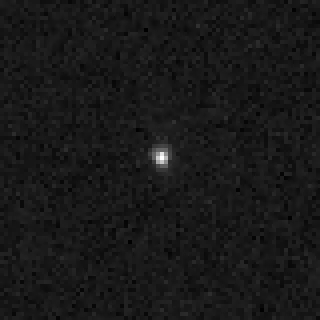
Telescope image · NASA, ESA, M. Brown (Hubble), public domain · source
About Sedna
Status
Active
Today
One of the reddest objects in the solar system, roughly 900 km across. Its enormous orbit never comes closer than 76 AU, so Neptune cannot have pushed it there: a passing star or an unseen planet may have. It is nearing its closest point to the Sun (2076).
Questions and answers
When will Sedna be closest to the Sun?
In 2076. Astronomers are studying it now, while it is near that point and at its brightest; afterwards it will fade for thousands of years.
How big is Sedna?
Roughly 900 km, but the estimates range from about 650 to 1,200 km: it is too far and too faint to measure precisely yet.
Where the numbers come from
Values refresh every second in your browser; the published data are checked every 10 minutes and updated several times a day.