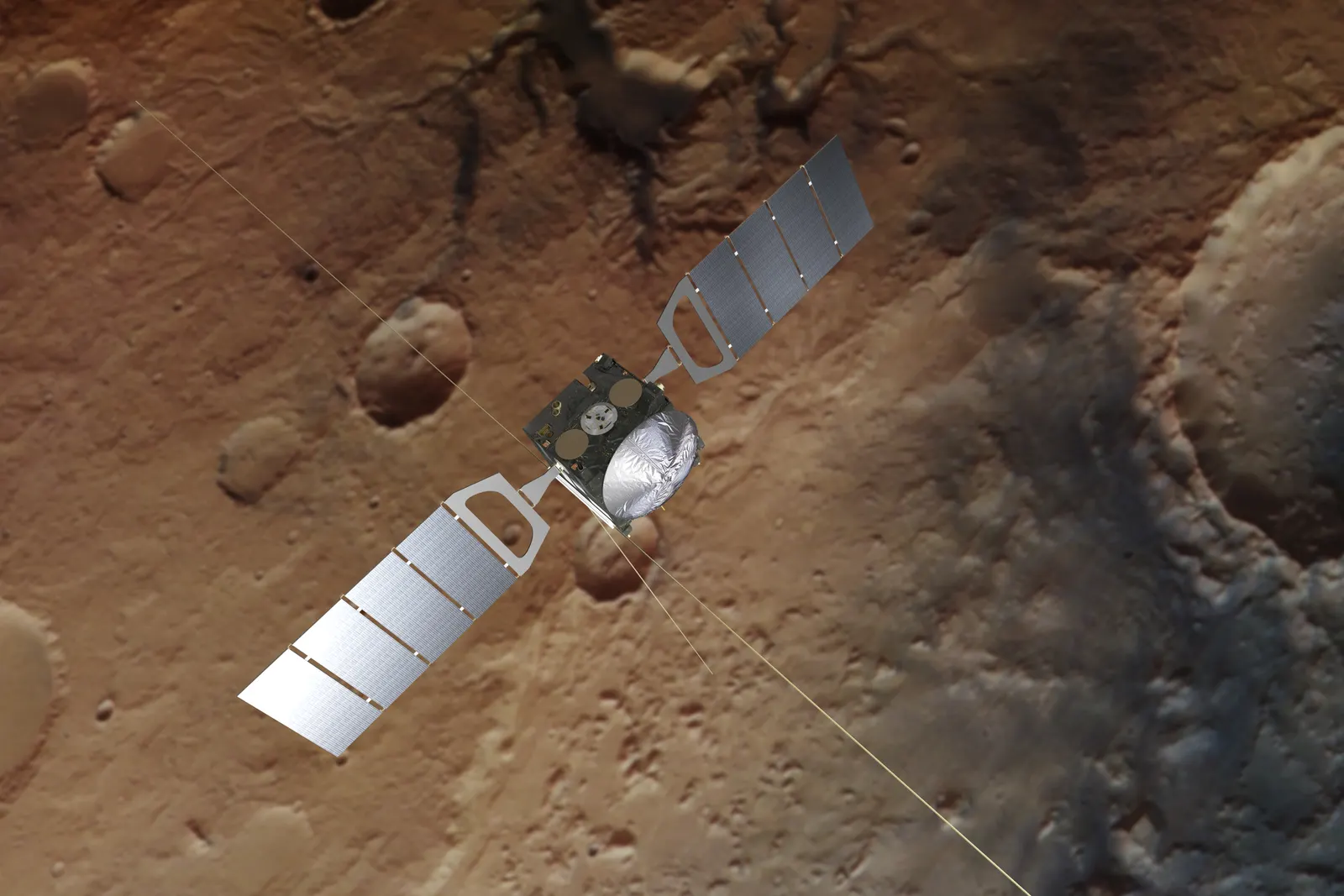
Mars Express, ESA’s first mission to another planet, has orbited Mars since 2003 on an elongated path over its poles; its live position is computed below.
Mars Express was launched on 2 June 2003 and reached Mars on 25 December 2003. Unlike orbiters that keep a constant height, it flies an elongated orbit: it dips to about 300 km above the ground, then swings out to about 10,000 km, going round in about seven and a half hours. Close passes give sharp images; the far part of the orbit offers wide views and lets it fly near Mars’s small moon Phobos. Its camera makes 3D views of the landscape, its radar probes beneath the surface and its spectrometers analyse the air and the minerals, to trace the history of water on Mars. ESA extended the mission again in June 2026.
Mars Express, ESA's first mission to another planet, studies Mars from below its surface to its upper atmosphere, as well as its two moons, Phobos and Deimos. Its camera produces 3D views of the landscape, its radar probes beneath the surface and its spectrometers analyse the air and the minerals. A central goal is to trace the history of water and whether early Mars could have hosted life.
Today
In Mars orbit since 2003-12-25. ESA's Science Programme Committee endorsed a further extension in June 2026 (previously confirmed to 2026-12-31); a July 2026 conference abstract describes a proposed 2027–2029 extension with instruments in good technical condition. ESA image releases continue through October 2026.
Yes, the British lander Beagle 2, which went silent after its descent in December 2003; images from NASA’s MRO found it on the surface in 2015, partly unfolded.
Why is its orbit so elongated?
It mixes close, detailed views with distant, wide ones, and lets the spacecraft study the planet, its atmosphere and its moon Phobos from very different heights.
Where the numbers come from
Values refresh every second in your browser; the published data are checked every 10 minutes and updated several times a day.