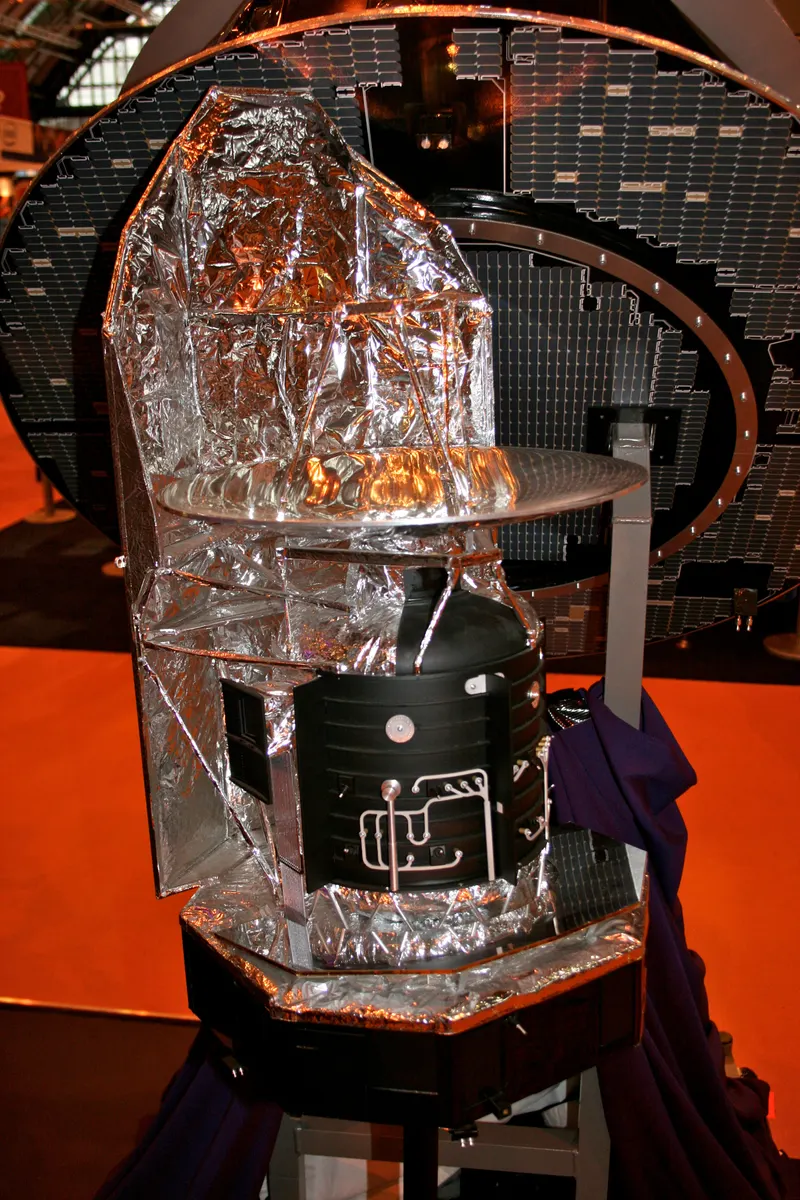
ESA’s Herschel infrared observatory, switched off in 2013 when its coolant ran out, circles the Sun on a parking orbit; its live distance is computed below.
The Herschel Space Observatory, launched on 14 May 2009 with the Planck satellite, was the largest infrared telescope sent to space before JWST, with a mirror 3.5 m across. Infrared light is heat, so a telescope that looks for the faint warmth of cold dust must itself be colder still. Herschel’s instruments sat in a tank of liquid helium that kept them a few degrees above absolute zero, and the helium slowly boiled away. Working from the Sun–Earth L2 point, it revealed long filaments of gas and dust where stars are born and traced water from interstellar clouds to comets. When the helium ran out on 29 April 2013, science stopped; it was moved to an orbit around the Sun and switched off on 17 June 2013. The position shown is NASA/JPL’s predicted trajectory.
Replica or test model · Mike Peel (www.mikepeel.net), CC BY-SA 4.0 · source
About Herschel Space Observatory
Agency
ESA
Launched
2009-05-14
Status
Ended
Goals
Herschel, with a 3.5 m mirror, was the largest infrared telescope sent to space before JWST, observing the cold and dusty Universe in far-infrared light. It revealed the long filaments of gas and dust where stars are born in our galaxy, traced water from interstellar clouds to planet-forming discs and comets, and found distant galaxies forming stars at a furious pace.
Today
Science ended on 2013-04-29 when its liquid helium coolant ran out. Thruster burns then moved it from the Sun–Earth L2 point to a heliocentric parking orbit; the last command, sent on 2013-06-17 after a final burn had emptied its tanks, switched it off. JPL Horizons publishes its predicted trajectory, so the position shown is a prediction, not a measurement.