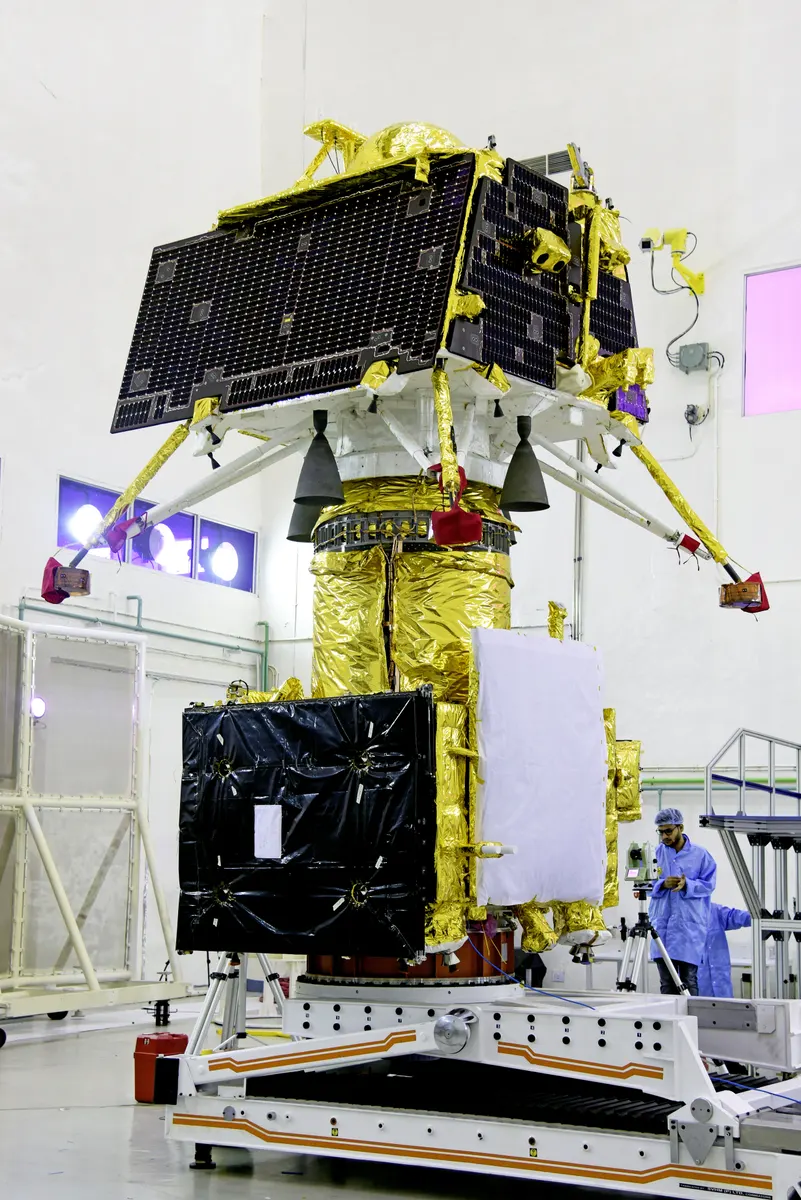
The orbiter of India’s Chandrayaan-2 mission circles the Moon in a low orbit over its poles; its live position is computed below.
Chandrayaan-2 was launched by the Indian Space Research Organisation (ISRO) on 22 July 2019. It carried an orbiter, a lander called Vikram and a small rover. The landing attempt failed in September 2019, but the orbiter, the part that stays in space, was not affected. It circles the Moon about 100 km above the ground on a path that passes over both poles. Its eight instruments map the minerals and chemical elements of the surface, look for water molecules and ice near the poles, and study the Moon’s extremely thin atmosphere. It was planned to work for seven years; ISRO still describes it carrying out its science.
Photo · Indian Space Research Organisation (ISRO), GODL-India · source
About Chandrayaan-2 Orbiter
Agency
ISRO
Launched
2019-07-22
Status
Active
Goals
The Chandrayaan-2 orbiter studies the Moon from a low polar orbit with eight scientific instruments. It maps the minerals and chemical elements of the surface, looks for water molecules and ice in the polar regions, and studies the very thin lunar atmosphere. These data help scientists understand how the Moon formed and evolved.
Today
Planned 7-year life reached around mid-2026; no end-of-mission announcement found as of 2026-10-24. ISRO's own page still describes the orbiter performing its scheduled science experiments.